











The Most Valuable Data You Throw Away Every Day
Your business spends real money finding out what customers want. Surveys, review requests, analytics, the odd focus group if you are big enough. Meanwhile, every working day, people ring up and simply tell you: what they need, what confused them, what your competitor quoted, why they nearly didn't call. It is the highest-quality customer research available anywhere, it arrives free, and in most Australian businesses it is destroyed within seconds of the handset going down.
That is not laziness. Until recently the phone system had no way to tell anything else what had happened. It was a box in a comms cupboard with a job description from 1994: connect audio, hang up, repeat. Everything else in the business learned to talk to everything else (the website feeds the CRM, the CRM feeds the mail platform, the roster feeds payroll) and the phones sat there in silence, generating the best data in the building and writing none of it down.
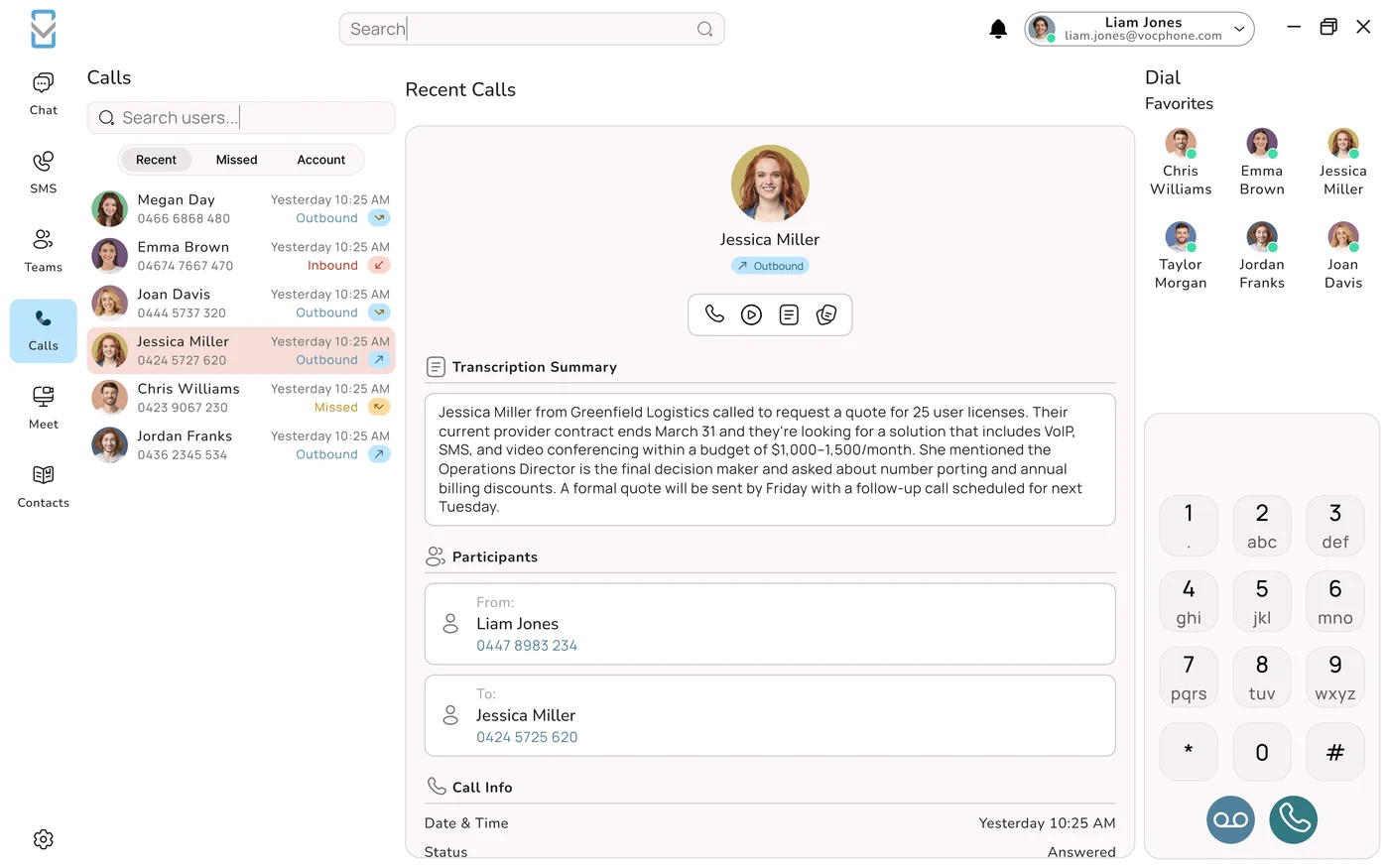
A cloud platform closes that gap, and the mechanism is worth understanding because it is what all of the following depends on. Calls become events. A call arriving is an event carrying a phone number, which is enough to look the caller up before anyone answers. A call ending is an event carrying duration, handler, outcome and, with AI transcription on, a full text record and a summary. Events can be sent places. That single change is the whole of what people mean by "integration".
"We weren't short of leads. We were short of a record of the leads. Half our follow-ups were someone trying to remember a Tuesday conversation."
a common opening line in VOCPhone onboarding callsSeven Integrations That Change a Working Day
Before the mechanics, the point. These are the seven that Australian businesses most often tell us earned their keep inside the first month, not the most impressive-sounding, the most used.
Call logging with AI summaries
The call writes itself to the customer record: duration, handler, recording link, a written summary and the follow-up actions. Removes the admin nobody was doing, and makes handovers between staff painless.
Screen pop on inbound
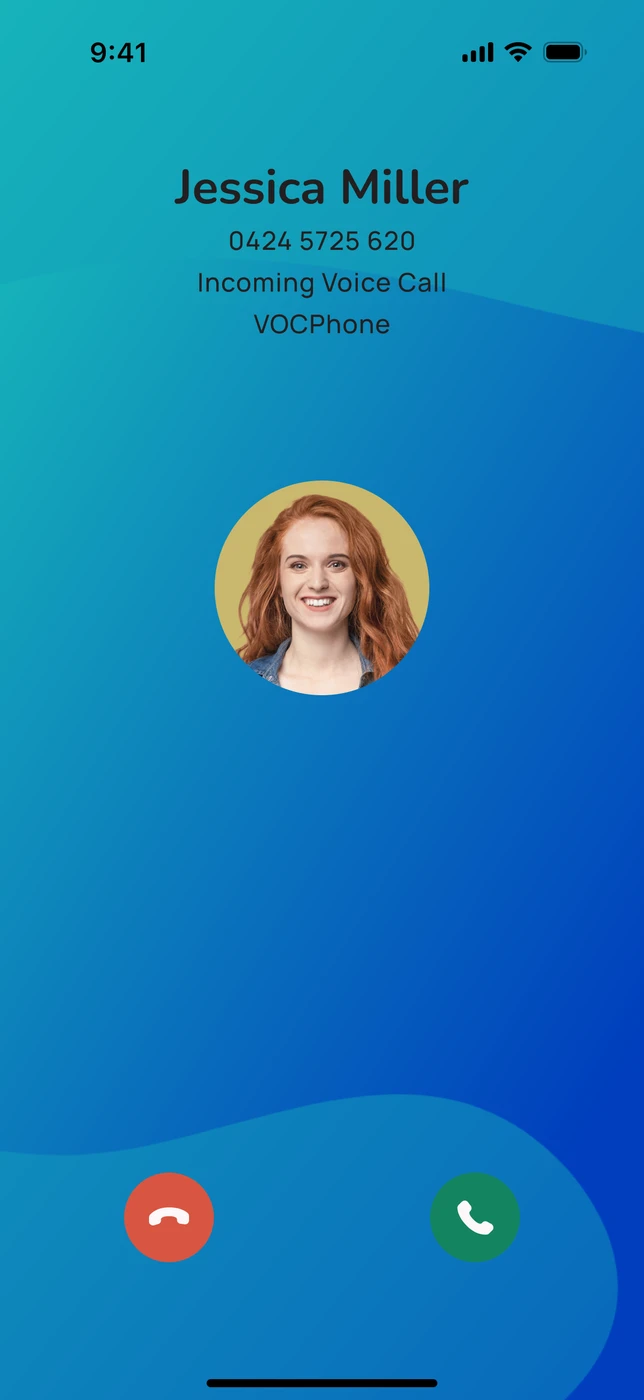
The record is on screen before the second ring. "Morning Sarah, the Wednesday install?" instead of "Can I take your name?" Callers read it as competence, and it takes real seconds off every enquiry.
Missed-call auto-text
A missed call triggers an instant SMS offering a callback. For trades and service businesses this is routinely the single highest-return automation in the entire stack.
Live calendar booking
Your AI Phone Agent checks real availability and books into the real diary at 9pm on a Sunday. No double bookings, no "I'll confirm and ring you back".
Accounts lookup on the ring
Outstanding invoices surface as the customer calls. Awkward conversations get shorter, and debtor days quietly improve without anyone chasing.
Marketing attribution
Different numbers on different campaigns, all reporting to one place. You finally know which spend generates phone calls rather than clicks.
HR-driven provisioning
A new starter in your HR platform gets an extension, a number, a queue and an app login automatically. Offboarding runs in reverse, which is a security control, not just a convenience.
Notice what is missing from that list: nothing exotic. No custom-built integration, no data science project. Six of the seven are configuration rather than development. That is the honest state of phone integration in 2026: the high-value work is mostly switching on things that already exist and deciding where the data should land.
The Four Methods, Honestly Described
"1,000+ integrations" is a stack, not a mechanism. Four layers, four sets of trade-offs. Being able to tell them apart is what separates an integration project that lands in a week from one that limps for a quarter.
Native integrations: built and maintained by us
These run in real time, inside the call. They are what makes screen pop, click-to-dial and instant two-way sync possible, and they exist for the systems most businesses genuinely live in: the major CRMs, helpdesks, job management and accounting platforms. The critical detail buyers miss is who maintains them. When a CRM vendor changes their API, and they do, a native integration is our problem to fix. A hand-rolled one is yours, and you will usually find out via a staff member mentioning that call notes stopped appearing three weeks ago.
Webhooks: we tell you the instant it happens
You register a URL, choose your events, and we POST a signed JSON payload the moment something occurs: ringing, answered, ended with outcome, missed, voicemail left, SMS received, transcript ready. No polling, no delay, nothing missed between fifteen-minute checks. This is how the cleverest automations get built: a missed-call event that texts the caller and queues a callback, or a transcript-ready event that appends a summary to a candidate file.
Two webhook mistakes worth avoiding
Validate the signature. A webhook endpoint is a public URL; without signature checking, anyone who finds it can inject fake call events into your systems. Acknowledge first, process second. Reply immediately and queue the work: endpoints that do their heavy lifting before responding will time out on a busy Monday and silently drop events.
The open REST API, for anything bespoke
Conventional in the best way: HTTPS, token auth, JSON in and out. It gives your developers programmatic access to call records and call detail, call control including click-to-dial from software we have never seen, SMS send and receive, user and number provisioning, and recordings and transcripts. This is what makes the platform genuinely open rather than merely configurable, and at VOCPhone it comes with the plan, not with an enterprise tier.
The honest caveat: an API is a capability, not a solution. Without a developer or an MSP, treat it as insurance against future lock-in rather than something you will use next month.
Zapier, Make and Power Automate: the long tail, no code
Rather than build a connector to every app in existence, we publish triggers and actions to the automation platforms, and they handle the wiring to the thousands of apps that have done the same. This is where the bulk of any "1,000+" figure genuinely lives, and it is legitimately useful, but know the two limits. Latency is seconds to a minute, so nothing that needs to happen during the ring. And pricing is per task, so an automation that felt free in testing can become a real monthly line item at 3,000 calls a month. Do that maths before you scale it.
The Timing Test: During the Call or After It?
If you remember one thing from this article, make it this. Almost every integration question answers itself once you ask when the thing needs to happen.
During the ring
Needs: native integration or direct API call.
Caller lookup, screen pop, routing based on who is calling, priority for key accounts, showing open jobs or unpaid invoices. Two seconds is the entire budget. Nothing event-driven is fast enough.
The moment it ends
Needs: native integration or webhook.
Call logging, AI summary written to the record, missed-call text, instant escalation of a complaint. Sub-second to a few seconds, and it must never be missed, which is why webhooks beat polling here.
Some time afterwards
Needs: iPaaS is perfect.
Tasks, tickets, deal-stage updates, channel notifications, spreadsheet rows, nurture sequences, satisfaction surveys. A thirty-second delay is invisible, so use the cheapest and fastest thing to build.
Pick Your Method: The Decision Matrix
Take this to your next vendor conversation and ask them to fill in the right-hand columns for your apps.
| What you want | Method | Speed | Developer needed? |
|---|---|---|---|
| Customer record on screen before you answer | Native | During the ring | ✓ No |
| Click a number in your CRM to dial it | Native | Instant | ✓ No |
| Every call + AI summary on the contact record | Native | Seconds after hang-up | ✓ No |
| Route VIP callers straight to their account manager | Native | During the ring | ✓ No |
| Auto-text anyone whose call you missed | Webhook or iPaaS | Instant to ~1 min | Webhook yes, iPaaS no |
| Create a task or support ticket after a call | iPaaS | Seconds to ~1 min | ✓ No |
| Live wallboard on the office TV | REST API | Whatever you poll | ✗ Yes |
| Push call data into a warehouse or BI tool | API + webhooks | Near real time | ✗ Yes |
| Trigger calls or SMS from your own software | REST API | Instant | ✗ Yes |
| Provision a new starter from your HR platform | API or iPaaS | Seconds | Depends on the HR app |
| Make call history readable by an AI agent | Native, then MCP | Ongoing | ✓ Usually no |
The MCP Moment: Why This Suddenly Got Strategic
Integration used to be an IT hygiene topic. In 2026 it became a strategic one, and the reason is a standard most business owners have never heard of.
Through 2025 and into 2026, the Model Context Protocol (MCP) became the common way for AI assistants and AI agents to reach into business systems: one interface instead of a bespoke connector per tool. It gets called "USB-C for AI", and the major CRM vendors have been shipping support for it. The practical effect is that AI is rapidly becoming able to answer real questions across your business software.
Which surfaces an uncomfortable gap. Ask an AI assistant to summarise every conversation your team had with your ten biggest customers this year and, for most Australian businesses, it cannot, not because the model is incapable, but because the conversations were spoken, not written. The single richest source of customer truth in the building is also the one most likely to be missing entirely from the data an AI can reach.
The bit you can't fix later
Almost everything else in an AI project can be backfilled. Call history cannot. You cannot retrospectively transcribe a conversation that was never recorded, or attribute a call that was never logged. Whatever you switch on today is the earliest date your AI-readable customer history can ever begin, which makes "turn on call logging and transcription" a cheap decision with a compounding return.
You do not need an AI strategy to act on this. You need your calls logged, transcribed and attached to the right customer, held onshore, in a platform that speaks modern standards. Do that now and every AI capability you adopt over the next three years inherits a complete history for free.
Where the Phone Fits in an Australian SME Stack
Most Australian small and medium businesses have converged on a recognisable set of software: accounting, a CRM, an HR and payroll platform, something for jobs or projects, a helpdesk if they support customers, Microsoft 365 or Google Workspace underneath, and a messaging tool. What is striking is how often the phone system is the only thing in that list not connected to anything else: the one remaining island in an otherwise well-wired estate.
That matters more than it sounds, because voice is the layer that touches all the others. A sales call is CRM data. A support call is helpdesk data. A payment chase is accounting data. A rostered on-call shift is HR data. Leave the phone disconnected and you are not missing one integration, you are missing the join between every system you already pay for. We map this out in more detail in our guide to the small-business tech stack for 2026.
Where VOCPhone stands
Integrations and open API access come with the platform rather than as an add-on module. We own and operate our own network instead of reselling somebody else's, which is how we hold 99.99% uptime and why third-party systems never sit in your voice path. Call data, recordings and transcripts stay on Australian infrastructure. Connector maintenance is ours when a vendor changes their API. And our price guarantee means the integrations you come to depend on cannot be repriced out from under you at renewal.
A Rollout That Doesn't Stall in Week Three
Integration projects fail the same way every time: too many connectors, too fast, and nobody owning the field mapping. This sequence works.
Name the one thing that annoys you most
Not a list: one. "Nobody logs calls." "We lose after-hours enquiries." "I can't tell which ads make the phone ring." Your first integration is whichever one kills that.
Find out which method covers your app
Ask directly: native, iPaaS, or API build? That single answer sets your cost, timeline and ceiling. Any honest provider will tell you straight, and a refusal to be specific is itself the answer.
Decide the field mapping in writing
Where does the summary land? Where does the recording link live? What happens when a caller's number isn't in the CRM: create a record or flag it? Ten minutes here prevents a year of messy data.
Pilot with one team for a fortnight
One office, one queue, one salesperson. You will always want to change one mapping decision, and finding that with five users costs nothing.
Roll out, then deliberately stop
Let it bed in for a month before the next one. Two integrations everybody trusts beat eight nobody is sure about.
Diary a six-monthly credential review
Scoped tokens, not shared admin logins. Rotate them and revoke the ones for systems you have dropped. Everyone skips this; auditors never do.
Nine Questions Worth Asking Before You Sign
- Is my app native, iPaaS, or an API build? "We integrate with everything" is not an answer.
- One-way or two-way sync? One-way logging is handy. Two-way is what powers click-to-dial and live presence.
- Can I read the API documentation before I sign? If not, ask why not.
- Are webhooks signed, and can I choose my events?
- Who fixes the connector when the CRM vendor changes their API? The right answer is the phone provider, at no charge.
- Does any of this cost extra, per user, per connector, per tier? Ask explicitly and get it in the quote.
- Where is my call data hosted, and where does it go when it leaves? Onshore matters under the Privacy Act, and it matters more once recordings are involved.
- Can I export all of it if I leave? Call history, recordings, transcripts. Vagueness here means your data is a retention strategy.
- What's your plan for AI agent access: MCP or equivalent? A provider with no view on this is not thinking ahead for you.
Frequently Asked Questions
When a provider claims 1,000+ integrations, what are they really counting?
Three different things bundled into one number. A modest set of native integrations the provider builds and maintains itself, mostly the big CRMs and helpdesks, which is where screen pop and click-to-dial come from. A very large set reachable through automation platforms like Zapier, Make and Power Automate, where the phone system publishes triggers and actions and the platform handles the rest. And an open REST API plus webhooks, which technically makes the number unlimited. Most of the headline figure comes from the second and third buckets. That is completely normal in 2026, but the question that matters is never how many apps in total, it is which bucket your app sits in, because that determines what the integration can actually do and how long it takes to stand up.
Why can't Zapier do screen pop?
Because screen pop has to happen inside the two or three seconds while the phone is still ringing, and automation platforms are event-driven with latency measured in seconds to a minute. By the time a Zap fires, your receptionist has already answered. Anything that needs to happen during the ring, so caller lookup, screen pop, live presence, or intelligent routing based on who is calling, needs a native integration or a direct API call. Everything that happens after the call ends, such as tasks, tickets, notifications, spreadsheet rows and deal-stage updates, is a perfect fit for Zapier or Make. Splitting your thinking along that line, during the call versus after the call, makes almost every integration decision obvious.
Do I need a developer to connect VOCPhone to my CRM?
Not for the mainstream systems. Connecting VOCPhone to a major CRM is a sign-in-and-authorise job in the admin console, followed by a short conversation about which fields call data should write to. Most businesses are live the same day, and our Australian-based onboarding team does the mapping with you rather than emailing you a PDF. You only need a developer for genuinely custom work: pushing call events into software built in-house, driving calls from your own application, or a workflow no connector covers. That is what the open REST API and webhooks exist for, and they are available to every customer rather than locked behind an enterprise tier.
What is MCP and why should a phone system care about it?
MCP, the Model Context Protocol, is an open standard that gives AI assistants and AI agents one common way to reach into business systems. It gets described as USB-C for AI, and through 2025 and 2026 the major CRM vendors have been shipping support for it. It matters enormously for telephony because the richest record of what your customers actually think is what they said out loud on the phone, and in most businesses that record does not exist in any form an AI can read. If your calls are transcribed, summarised and attached to the right customer in a system that speaks modern standards, every AI capability you adopt from here inherits that history automatically. If they are not, you are starting from an empty dataset, and you cannot go back and transcribe a call nobody recorded.
Can an integration outage take my phones down?
Not with a sensible design, and this is worth checking with any provider. Voice traffic and integration traffic travel separate paths: calls run over SIP and RTP between your app or handset and our network, while integration events go over HTTPS to whichever third-party system is involved. If your CRM has an outage, calls keep connecting normally and you simply lose the screen pop and the automatic note until it comes back. VOCPhone owns and operates its own network rather than reselling someone else's, which is how we hold 99.99% uptime on the voice path, and we deliberately keep third-party systems out of that path. If a provider cannot explain this separation clearly, ask harder questions.
Does integration cost extra on top of the per-user price?
It should not, and this is one of the most common places a headline per-seat price quietly grows. Ask three specific questions of anyone you are evaluating: is CRM integration included in the plan or an add-on module, is the REST API available on my tier or enterprise-only, and is there a per-connector or per-user integration fee. With VOCPhone, integrations and API access come with the platform, and our price guarantee means you are not exposed to the classic pattern of a cheap year one followed by a renewal that reprices everything you have come to depend on.
Which single integration gives the fastest return?
For almost every Australian business it is automatic call logging with AI summaries into whichever system your team already has open all day, usually the CRM, the job management app or the accounting package. It wins because it requires zero behaviour change from staff, it removes admin they were probably not doing anyway, and it pays back on every single call rather than occasionally. The close runner-up, particularly for trades and service businesses, is missed-call auto-text, because it converts a lost enquiry into a live one for the price of an SMS. Set up one of those two, let it settle for a fortnight, and only then add the next.