











UCaaS, Without the Jargon
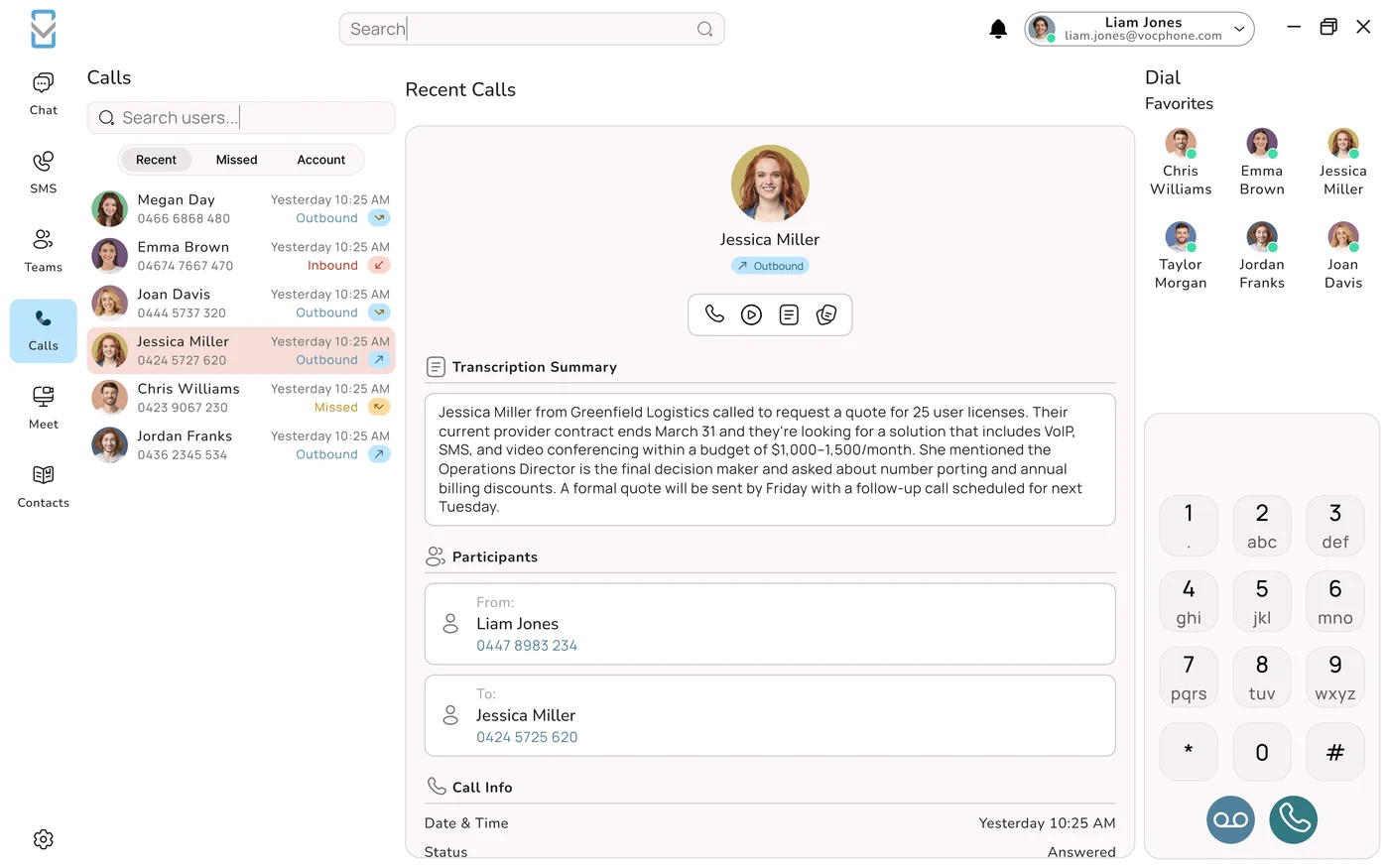
UCaaS is short for Unified Communications as a Service. Strip away the acronym and it describes something simple: a single cloud platform that handles every way your business communicates, phone calls, video meetings, team chat, text messages, and now AI, and hands it to you as a monthly per-seat subscription. There is no switchboard humming in a cupboard and no separate contracts for a phone line, a video tool and a texting service. One app on your laptop and your phone does all of it.
The "as a service" bit is the modern part. You are not buying and depreciating hardware; you are subscribing to software that a provider runs, patches and upgrades for you. Hire someone, add a seat. Lose someone, drop a seat. It flexes with your headcount the way a streaming plan does, not the way a capital purchase does. That is a fundamentally different relationship with your phone system than the one most Australian businesses grew up with.
Unified communications is the idea; UCaaS is that idea delivered from the cloud. The point of it all is to end the everyday fragmentation businesses have quietly accepted, where a call happens on one system, the follow-up meeting on another, the internal chat about it on a third, and the customer's record in a fourth that talks to none of them. UCaaS folds those silos into a single connected experience so a conversation can move from a call to a video to a text without ever leaving the platform, or the customer's history behind.
How we got here
Business phones have gone through three eras. First, the on-premise PBX: a physical switch bolted into your building, wired to desk phones and maintained by a technician who charged a call-out fee. Then VoIP arrived and lifted calls onto the internet, killing line rental and adding flexibility. UCaaS is the third era, taking that cloud calling and wrapping video, messaging, SMS, presence, apps, integrations and AI around it, all run as one hosted service.
Remote and hybrid work poured fuel on the shift. Once your people are split between an office, a kitchen table and a job site, a phone screwed to a desk stops being an asset and becomes a liability. A platform that follows the person rather than the desk is no longer a luxury, and that is exactly why UCaaS adoption among Australian small and mid-sized businesses kept climbing through 2025 and into 2026.
1
platform and one bill instead of four or more separate tools
99.99%
network uptime on the VOCPhone network
15+
years VOCPhone has operated in the Australian market
24/7
Australian-based human support, not a ticket queue
UCaaS vs VoIP vs CCaaS
These three acronyms get thrown around as if they mean the same thing. They do not, and knowing the difference is the quickest way to stop yourself either overpaying for a contact-centre platform you will never fill or underbuying a bare phone line when you needed a whole communications stack.
VoIP is the plumbing, not the house
VoIP (Voice over Internet Protocol) is the underlying technology that carries a call over the internet instead of a copper pair. It is a single capability. A basic VoIP service gives you cloud calls, voicemail and maybe simple forwarding, and that is where it stops. Every UCaaS platform uses VoIP to make its calls, but VoIP on its own is just the phone part. Calling it a communications solution is like calling a tap a kitchen.
UCaaS is the whole communications platform
UCaaS uses VoIP for calling and then adds HD video, team messaging, SMS, presence, desktop and mobile apps, integrations and AI, all under one login and one bill. It is designed for communication across a whole organisation: staff talking to each other and to customers, meeting, messaging and collaborating. For the vast majority of Australian small and mid-sized businesses, this is the category that fits.
CCaaS is the specialist tier most businesses skip
CCaaS (Contact Centre as a Service) is built for high-volume customer teams, think dozens or hundreds of agents fielding thousands of interactions a day. It layers on advanced queuing, skills-based and priority routing, workforce management, quality monitoring and deep contact-centre analytics. If you run a genuine call centre, you need it. If you are a clinic, a trades business, an agency or a shopfront, you almost certainly do not, and the line keeps blurring because modern UCaaS platforms now include AI call agents, queues and ring groups that comfortably cover what a smaller team actually needs. VOCPhone is a case in point: its AI Phone Agents handle inbound calls, and its queuing and routing cover most contact needs inside the one platform.
The one-line version
VoIP is calls in the cloud. UCaaS is your entire communications stack, calls, video, chat, SMS, presence and AI, on one platform. CCaaS is a heavyweight contact-centre system for large agent teams. Most Australian businesses want UCaaS, and a UCaaS platform with built-in AI usually removes any reason to buy CCaaS separately.
What Actually Lives Inside a UCaaS Platform
A real UCaaS platform is more than a phone system with a chat box glued to the side. These are the parts you should expect to find, and the ones VOCPhone brings together in one Australian-owned platform.
Cloud Calling
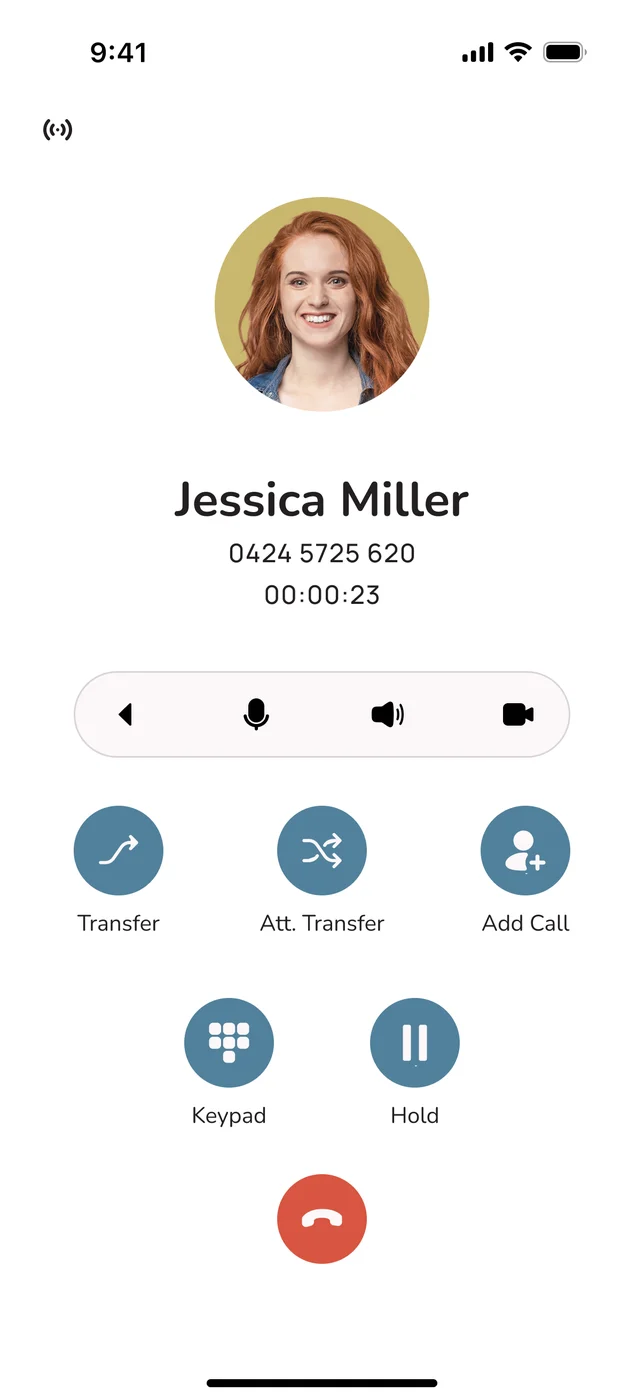
Full business telephony over VoIP: extensions, IVR menus, call queues, ring groups, hold and transfer, with no physical PBX in the building and unlimited calls on plan.
HD Video Meetings
Untimed video for up to 30 participants, launched from the same app you call from, so client meetings and internal huddles never need a separate licence.
Team Messaging
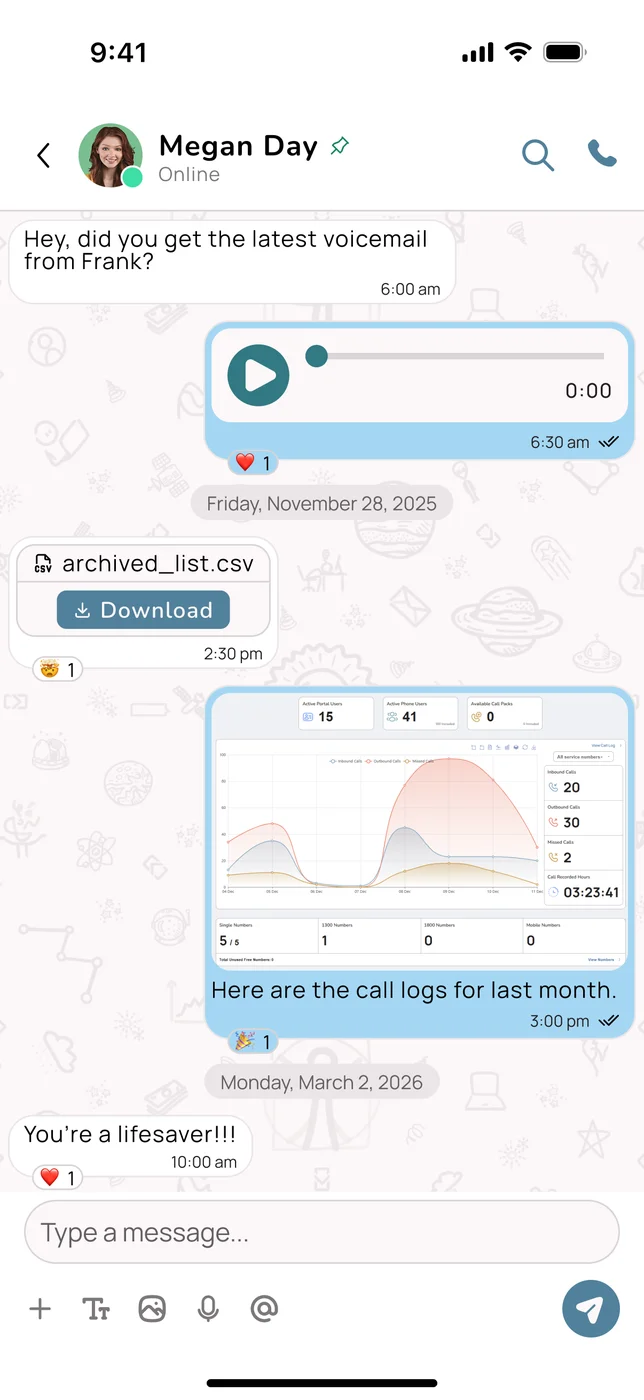
One-to-one and group chat so quick questions do not need a call, kept on the same platform as your calls and meetings rather than in yet another app.
Desktop & Mobile Apps
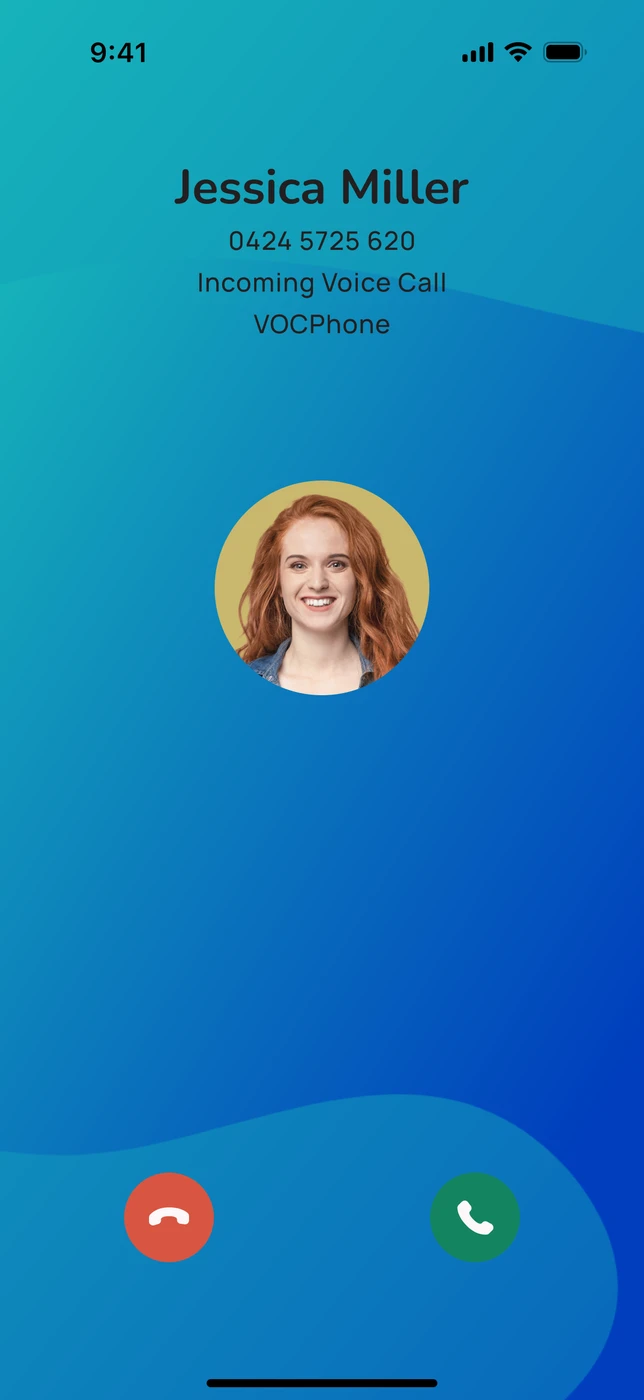
Apps for Windows, Mac, iOS and Android. Your business number and full feature set travel with the person between office, home and the road.
Business SMS
Two-way texting from your business number for reminders, confirmations and quick replies, threaded alongside your calls, not stranded on a personal phone.
Presence
See at a glance who is free, on a call or away, so calls route to the right person the first time instead of bouncing around the office.
Integrations
Two-way links to Salesforce, HubSpot, Zoho, Xero, Monday and more than a thousand other apps, plus open APIs for anything custom.
AI Phone Agents
AI receptionists that answer 24/7 in natural Australian accents, book appointments, qualify leads and route calls, built into the platform, not sold separately.
Recording & Reporting
Call recording plus unified reporting on calls, missed calls and response times, managed from one dashboard rather than stitched together from exports.
The word that carries all the weight here is unified. It is not enough for a provider to offer these as nine products you bolt together yourself. In a true UCaaS platform they share one directory, one presence status, one set of integrations and one bill. A call can become a video meeting, a message can point at the same contact record, and every interaction lands in the same reporting view. That coherence is the entire reason UCaaS exists.
AI: Now Part of the Platform, Not a Bolt-On
Through 2025 and into 2026, AI stopped being a novelty tab in the settings and became a core layer of the platform. The models underneath got faster and far cheaper to run, which pushed capabilities that were once enterprise-only into the tools ordinary Australian businesses can actually afford.
The AI that earns its place
- AI Phone Agents: trained on your business, they answer inbound calls around the clock in natural Australian accents, qualify and route them, and book appointments, without leave, sick days or a lunch break.
- Live transcription: calls are written up as they happen, so there is an accurate record without anyone scribbling notes.
- Call summaries: instead of a full transcript, staff get a tight summary of what was discussed and what needs to happen next.
- Voicemail-to-text: missed messages arrive as readable text, so nobody has to wade through a voicemail inbox.
- Call insight: patterns in why people ring, and where they get stuck, turn a pile of calls into something you can act on.
The catch: included or invoiced
This is where providers separate. Plenty of international platforms treat AI as a premium upsell, locking transcription, insight and call agents behind their dearest tier or charging per-minute add-on fees. You sign up expecting an AI-powered platform and discover the AI is a separate line, sometimes bigger than the base plan.
VOCPhone takes the other road: AI Phone Agents are part of the platform. They are tuned to your business and speak with genuine Australian accents, which matters more than it sounds, models built on American English routinely trip over local place names, slang and the way we actually say things. When you compare UCaaS providers, ask the blunt question every time: is the AI included, or is it another figure on the invoice?
Read the fine print on "AI-powered"
"AI-powered" in a headline does not mean AI is included in your price. Before you sign, confirm exactly which AI features sit in the tier you will actually pay for, and whether any of them carry per-minute charges. A platform that advertises AI but bills it as a separate add-on is not really all-in-one, it is two products wearing one logo.
What Australian Businesses Gain From UCaaS
Folding your communications onto one cloud platform is not just neater; it changes how the business runs. Here is where it shows up, on the balance sheet and in the day-to-day.
One platform, one bill, one accountable provider
Instead of paying and troubleshooting a phone provider, a video tool, a chat app and an SMS gateway separately, you deal with one vendor, one invoice and one support line. That removes hours of admin friction every month and kills the finger-pointing that erupts the moment two systems refuse to talk to each other.
Remote and hybrid work, handled
Because the platform lives in the cloud and runs on apps, your team's full toolkit follows them. Staff answer the business line from home, transfer a live call to a colleague on site, and jump into a video meeting from a cafe, all on the same number and system. Location stops being a constraint on who can pick up.
Scaling is a setting, not a project
Adding users is a change in a dashboard, not a hardware job. Bring on five seasonal staff and drop them afterwards, with no technician visit, no new handsets to buy and no re-cabling. UCaaS grows and shrinks with your headcount in minutes.
Lower total cost of ownership
There is no capital outlay for a PBX, no maintenance contract, no rack of physical lines to rent, and no separate subscriptions for the tools UCaaS replaces. Total up what a fragmented stack really costs, phone, video, chat, SMS and the IT time to keep them talking, and a single per-seat subscription is almost always cheaper.
It keeps working when the office does not
Lose power or internet at the office and a cloud platform simply reroutes calls to the mobile apps automatically; customers never notice. An on-premise PBX, by contrast, goes dark the moment the power or the cable does, and stays dark until someone physically shows up to fix it.
The businesses that get the most from UCaaS are the ones that stop thinking about "the phones" as a thing in a cupboard and start thinking about every customer conversation as one connected thread.
The VOCPhone view on unified communicationsPBX vs VoIP vs UCaaS at a Glance
The clearest way to see where UCaaS sits is to line it up against what came before. The table compares a traditional on-premise PBX, a basic VoIP service, and a full UCaaS platform (using VOCPhone as the UCaaS example).
| Capability | On-premise PBX | Basic VoIP | UCaaS (VOCPhone) |
|---|---|---|---|
| Voice calling | ✓ On-site | ✓ Cloud | ✓ Cloud, unlimited |
| HD video meetings | ✗ | ✗ | ✓ Built in |
| Team messaging | ✗ | ✗ | ✓ Built in |
| Business SMS | ✗ | ~ Sometimes | ✓ Built in |
| Presence | ✗ | ~ Limited | ✓ |
| Desktop + mobile apps | ✗ Desk phone only | ~ Basic app | ✓ All platforms |
| AI Phone Agents | ✗ | ✗ | ✓ Included |
| CRM & app integrations | ✗ | ~ Limited | ✓ Salesforce, HubSpot, Xero, 1000+ |
| Scalability | ✗ Hardware project | ~ Per line | ✓ Add seats in minutes |
| Upfront hardware cost | ✗ High | ✓ Low | ✓ None required |
| Keeps working in an outage | ✗ | ~ Partial | ✓ Auto-reroute to mobile |
| Runs on a network the provider owns | ~ Your own kit | ~ Usually resold | ✓ VOCPhone-owned network |
The pattern is hard to miss. A traditional PBX is dependable but rigid, expensive and voice-only. Basic VoIP is cheaper and cloud-based but still just phone calls. UCaaS is the only column that unifies every channel, builds in AI and scales without hardware, which is precisely why it has become the default for Australian businesses upgrading in 2026.
How to Evaluate a UCaaS Provider
Once you have decided UCaaS is right, the harder question is who to buy it from. Feature lists look near-identical on marketing pages, so judge on the things that actually decide your experience and your bill.
1. Does the provider own its network, or resell one?
This is the criterion most comparison articles skip, and the one that matters most. A provider that owns and operates its own network controls the call path from end to end. A reseller sits on top of someone else's infrastructure, which means when quality drops or something breaks, they are raising a ticket with the real carrier just like you would. VOCPhone owns and runs its own network, which is why it can stand behind a 99.99% uptime figure rather than pointing at a supplier.
2. Is AI included or invoiced?
Confirm whether AI call agents, transcription and summaries are part of the plan you will pay for or an extra charge. As covered above, a platform that advertises AI but bills it separately is not truly all-in-one. VOCPhone includes AI Phone Agents in the platform.
3. Does it integrate with your actual stack?
Look for real, two-way integrations with the tools you already run, not just a generic connector. For Australian businesses that means Xero for accounting and Salesforce, HubSpot or Zoho for CRM. If a provider cannot connect natively to the systems you live in, your call and customer data will keep living in separate worlds.
4. Is support local and human?
When your communications platform has a problem, response time is revenue. Ask where support sits, whether it runs in your timezone, and whether you speak to a person or wait in a queue. VOCPhone provides Australian-based human support around the clock, not an offshore ticket system.
5. Is the pricing honest?
Look for transparent per-seat pricing without surprise tiers, per-minute overages or multi-year lock-ins with break fees. Some international providers also impose minimum seat counts, so you pay for capacity you do not use. VOCPhone uses transparent per-user pricing with unlimited calls, keeps your existing numbers through porting, and backs it with a price guarantee, so a genuine competitor quote will not leave you worse off.
The five questions, in order
1. Do you own your network or resell someone else's? 2. Is AI included in the price you just quoted? 3. Do you integrate natively with our CRM and Xero? 4. Is support local, human and around the clock? 5. Is the per-seat price all-in, with unlimited calls and no minimum seats? Ask these and the field narrows quickly.
The Network Question: Who Owns the Wires
This deserves its own section, because it is where most providers are quietly identical and one or two genuinely differ. A UCaaS platform carries your live voice and video. Unlike an email, these are real-time, so even small problems are immediately audible, the talk-over, the awkward gap, the call that drops mid-sentence.
Most "providers" in the market are resellers. They buy capacity on a carrier's network, wrap an app around it and sell it on. That is a perfectly normal business model, but it has a consequence: when call quality slips or the service goes down, the reseller does not control the fix. They log a fault with the underlying carrier and wait, and so do you. Uptime promises from a reseller are, in the end, someone else's promise repeated.
A provider that owns and operates its own network is in a different position. It controls the call path, can engineer for quality and redundancy directly, and is genuinely accountable for the number it puts on an SLA. VOCPhone is in that camp: Australian-owned, running on its own network, hosted in Australia, and backing the service with 99.99% uptime and Australian-based human support. There is one company responsible for the whole experience, which is exactly what you want the day something goes wrong.
Why owning the network wins
Accountability: one company owns the call path end to end, so faults do not get passed to a third party.
Reliability: an owner can engineer for redundancy and stand behind a real uptime figure, VOCPhone's is 99.99%.
Local control: the network, the hosting and the support are all Australian, so your data and your calls stay onshore and your support is in your timezone.
Where VOCPhone Fits
There is no shortage of cloud communications products. Very few are genuinely all-in-one and run on a network the provider actually owns. Here is what makes VOCPhone a true UCaaS platform for Australian business.
Owns Its Own Network
Not a reseller. VOCPhone owns and operates the network your calls run on, so it controls quality, redundancy and the 99.99% uptime it stands behind.
Australian Through and Through
Australian-owned, Australian-hosted, and 15+ years in the local market, with support staffed by real people in your timezone, around the clock.
AI Included, Not Extra
AI Phone Agents that answer 24/7 in natural Australian accents, book appointments and qualify leads are part of the platform, not a premium tier.
Everything on One Platform
Calls, HD video for up to 30 people, team messaging, SMS, presence, recording, IVR and queues in one system, not a phone line with tools bolted on.
Transparent Pricing, Price Guarantee
Clear per-seat pricing with unlimited calls, your existing numbers kept, and a price guarantee against genuine competitor quotes.
Integrations That Matter
Native, two-way links to Salesforce, HubSpot, Zoho, Xero, Monday and 1000+ apps, plus open APIs for custom builds.
The practical upshot: with VOCPhone you get the full unified communications experience, everything a UCaaS platform should be, without the reseller's diluted accountability, the AI upcharge, the minimum-seat traps or the offshore support queue. And because AI Phone Agents, queues and ring groups are built in, most small and mid-sized businesses get the customer-handling they need without paying for a separate CCaaS product. It is the same platform trusted by names like Harvey Norman, Ampol and Gold's Gym, and by smaller local operators such as Coco's Wealth of Health.
Moving to UCaaS Without the Drama
Shifting your whole communications stack sounds daunting. In practice, moving to a well-run UCaaS platform is a guided, low-risk process, and you keep working the entire way through. Here is the actual path from where you are today to your first call on the new system.
-
Book a walkthrough
Talk to the VOCPhone team via contact us or on 1300 663 222. You will see the platform, the AI Phone Agents and the integrations relevant to your business, mapped to your situation rather than a generic pitch.
-
Choose your seats
Pick your per-user plan and how many seats you need, then let the team map your current extensions, departments and call flows onto the new platform.
-
Port your existing numbers
Keep every business number. VOCPhone handles the porting, and your old service stays live until the port completes, so there is no gap and customers never notice.
-
Roll out the apps
Install the free desktop and mobile apps so staff can start calling straight away, no hardware purchase required. If you want desk or cordless handsets, VOCPhone can supply certified units.
-
Connect integrations, switch on AI, go live
Connect your CRM and accounting tools, train the AI Phone Agents on your business and set your routing. Onboarding is guided by the Australian team, who watch the first few weeks to make sure it all runs smoothly.
Frequently Asked Questions
What does UCaaS actually mean?
UCaaS stands for Unified Communications as a Service. It is a cloud platform that pulls every way your business talks to people, voice calls, video meetings, team chat, SMS and increasingly AI, into one system you pay for per user each month. Instead of a phone provider, a video app and a texting tool that never speak to each other, one login handles the lot from a desktop or mobile app. VOCPhone is an Australian example, running on a network it owns and operates rather than reselling someone else's.
What is the difference between UCaaS and VoIP?
VoIP (Voice over Internet Protocol) is the technology that carries a phone call over the internet instead of a copper line. It is one capability. UCaaS is the whole communications platform: it uses VoIP for calling but adds video, team messaging, SMS, presence, desktop and mobile apps, integrations and AI, all under one bill. In short, VoIP is your calls in the cloud; UCaaS is your entire communications stack in the cloud.
Do I need CCaaS instead of UCaaS?
Probably not. CCaaS (Contact Centre as a Service) is a heavyweight platform built for large teams handling thousands of interactions a day, with advanced queuing, skills-based routing and workforce management. UCaaS is built for how most Australian businesses actually work: staff calling, meeting, messaging and handling everyday customer contact. Because a modern UCaaS platform like VOCPhone includes AI Phone Agents, call queues and ring groups, most small and mid-sized teams get the customer-handling they need without buying a separate contact-centre product.
What is included in a UCaaS platform?
A genuine UCaaS platform brings together cloud calling, team messaging, HD video meetings, business SMS, presence, desktop and mobile apps, call recording, IVR and call queues, integrations with your CRM and accounting tools, and AI features such as call agents and voicemail-to-text. VOCPhone bundles these into one platform with unlimited calls and transparent per-seat pricing, rather than scattering them across tiers and add-ons.
Is AI part of UCaaS now?
Increasingly, yes. Modern UCaaS platforms build in AI for answering and routing calls, transcribing conversations, summarising calls and turning voicemail into text. The catch is that many providers gate AI behind their top tier or bill it as a per-minute extra. VOCPhone includes AI Phone Agents that answer 24/7 in natural Australian accents, book appointments and qualify leads, as part of the platform rather than a second invoice.
Why does it matter whether a provider owns its own network?
Because a UCaaS platform carries live voice and video, where and how it is delivered directly affects call quality, reliability and who is accountable when something breaks. A provider that owns and operates its own network, rather than reselling another carrier's, controls the call path end to end, can back a real uptime figure, and does not have to pass your fault to a third party. VOCPhone owns and runs its own network, is Australian-owned and hosted, and backs it with 99.99% uptime and Australian-based human support.
How hard is it to move to UCaaS?
Less disruptive than most businesses fear. You book a walkthrough, pick your seats, port your existing numbers, install the free desktop and mobile apps, connect your integrations and go live. With VOCPhone your existing numbers come across, the old service stays live until the port completes so there is no downtime, and onboarding is guided by an Australian team rather than left to you.
What to Read Next
This guide defined UCaaS and unified communications. These related reads go deeper into AI phone systems, hosted PBX, and choosing the right setup for your business.