











The Desk Is Empty More Than It Is Staffed
Count the hours your club or studio is open, then count the hours someone is standing behind the counter with nothing else to do. For a 24-hour gym that is 168 hours open against perhaps 40 to 60 staffed. For a boutique studio, the "desk" is often the instructor's phone in a bag at the back of the room while a class runs. Even a staffed club loses its desk in the 5pm to 7pm rush.
Most gym phone setups assume someone is there: a landline at reception, a voicemail box, maybe a menu. That fails in the hours that matter most, because people decide to join a gym in the evening, at the weekend and in the first week of January, and members have problems at the door at 5am.
168
Hours a week a 24-hour club is open. Staffed hours are usually a fraction of that.
1 Jul 2027
When the Unfair Trading Practices Act starts, including new rules for cancelling subscriptions.
48 hrs / 7 days
Cooling-off periods under the Queensland and WA fitness codes respectively.
So the useful question is not "which phone system has the best features?" It is "what happens to each kind of call when nobody is at the desk?" Answer that and the setup more or less designs itself.
The Calls a Club Actually Gets
Ask any gym manager to list last week's calls and the same handful come up. They are not equal.
| Call | When it tends to arrive | What the caller needs |
|---|---|---|
| Membership enquiry | Evenings, weekends, January | Prices, contract terms, what is included, and a time to look around. |
| Trial pass or intro offer | After seeing an ad or a social post | How it works, when they can start, what to bring. |
| Class booking or waitlist | The night before and the morning of | A spot, or to know where they sit on the waitlist. |
| Freeze or suspension | Before holidays, after injury | Whether they can, for how long, what it costs, and confirmation. |
| Cancellation | Any time, often right after a debit | A clear way to end the membership, the final payment date, and proof. |
| Billing and direct debit | Debit day | Why a payment failed or what a charge was for. |
| Access, fob or app problem | Early morning and late night, unstaffed hours | To get in, now. |
| Lost property | The day after | Whether it was handed in and when to collect. |
| Personal training | Daytime | A session with a specific trainer, or a callback. |
| Something has gone wrong in the club | Any time | A person, quickly. |
Two things stand out. First, most of the volume is the same few questions asked over and over. Second, the calls with the most money or the most risk attached (a new member, a cancellation, an incident) are the ones you least want going to a voicemail box nobody checks until Monday.
Person, AI Agent or On-Call Manager
Sort every call on that list into one of three lanes. Write them down before you touch any settings.
Lane 1: a person on the desk
During staffed hours, new member enquiries and anything about a member's own account should ring the desk first. Your staff can sell, and they can see the account. If the desk is busy, the call overflows rather than ringing out.
Lane 2: the AI agent
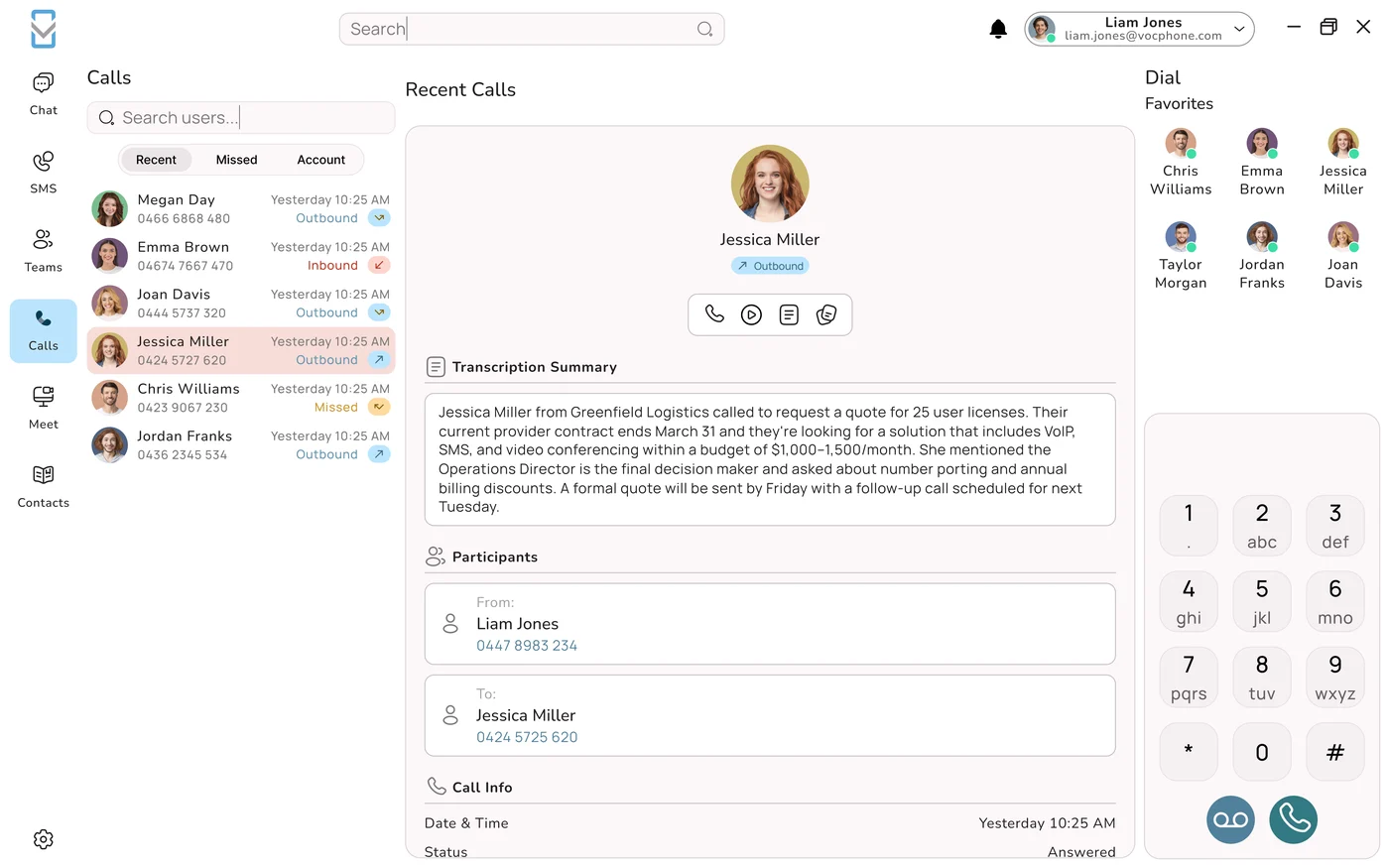
Prices, timetables, parking, what to bring, trial pass details, booking a tour, taking a freeze request and taking a message. Vocky, VOCPhone's AI phone agent, answers from the documents you give it, books into a calendar, texts a confirmation and leaves a recording, transcript and summary for the morning.
Lane 3: the on-call manager
A member locked in or out, a fault with the doors, an incident or an upset member. These transfer straight to a manager's mobile at any hour, with whatever the caller has already said passed along so they do not repeat it.
Not a lane: emergencies
Your phone system is not an emergency service. Signage, member onboarding and your agent's script should all say the same thing: if someone is hurt or in danger, call Triple Zero (000) first, then the club.
The order matters in a 24-hour club. Overnight there is no Lane 1, so the agent takes almost everything and sends the urgent few to Lane 3. During staffed hours the agent becomes the overflow, picking up when the desk is busy. Our guide to which calls to automate with AI goes deeper on drawing that line for any business.
Why not a phone menu?
A menu ("press 1 for memberships, press 2 for classes") still ends in voicemail when nobody is there. An AI agent can actually answer the question, book the tour and decide whether the call needs a manager. We explain the trade-off in why phone menus are the worst part of your business.
Cancellation Calls: Fair, Fast and Written Down
Cancellations are where fitness businesses get into the most trouble, and the phone is often where it starts. A member rings to cancel, is told they must come in person or fill out a form, the next debit goes through, and a complaint lands with the state regulator. Cancellation problems are the most common fitness complaint Consumer Protection WA receives, and regulators in several states publish guidance aimed squarely at gym members.
Rules differ by state, so check the code that applies where you trade. A few examples, current as at November 2026:
- Queensland has a mandatory fitness industry code. Members get a 48 hour cooling-off period when they join, and the Queensland Government tells members to cancel in writing.
- Western Australia has a mandatory Fitness Industry Code of Practice with a seven day cooling-off period. Consumer Protection WA says cancellations "can be requested by a simple email", with no need to attend in person or use a set form, and that the provider should confirm in writing within seven days.
- NSW guidance tells members to always cancel in writing so they can prove the date, and warns that terms stopping someone cancelling when seriously ill or injured may be unfair.
- Nationally, unfair terms in standard form contracts can attract penalties, the ACCC has warned gyms that advertising "No Contracts" is likely misleading if members must give written notice to leave, and the industry body AUSactive publishes a national code of practice for its members.
The bigger change is coming. The Competition and Consumer Amendment (Unfair Trading Practices) Act 2026 received Royal Assent on 6 July 2026 and commences on 1 July 2027. It bans subscription traps. Businesses selling ongoing memberships will need a straightforward, easy-to-find way to cancel that uses only reasonably necessary steps, with an online option where the member signed up online, and regulations will require reminders at key points such as before a renewal. When the government flagged the reforms in January 2026, its media release listed a gym membership among the typical New Year subscriptions and said cancelling should be "at least as straightforward as joining".
What this means for your phones
The Act does not require you to take cancellations by phone. But if members can ring, the call should never be a dead end. Set your AI agent and your desk script to do three things: accept the request, record it with the date and time, and send written confirmation by SMS or email with the next step and any final payment date under your terms. If you offer a freeze instead, offer it once and accept the answer. This is general information, not legal advice; talk to your adviser about your own contracts.
A phone system helps here. Every call to the agent is recorded, transcribed and summarised, so when a member says "I rang to cancel on the 3rd", you can check in a minute instead of arguing about it.
Class Reminders and Waitlists by SMS
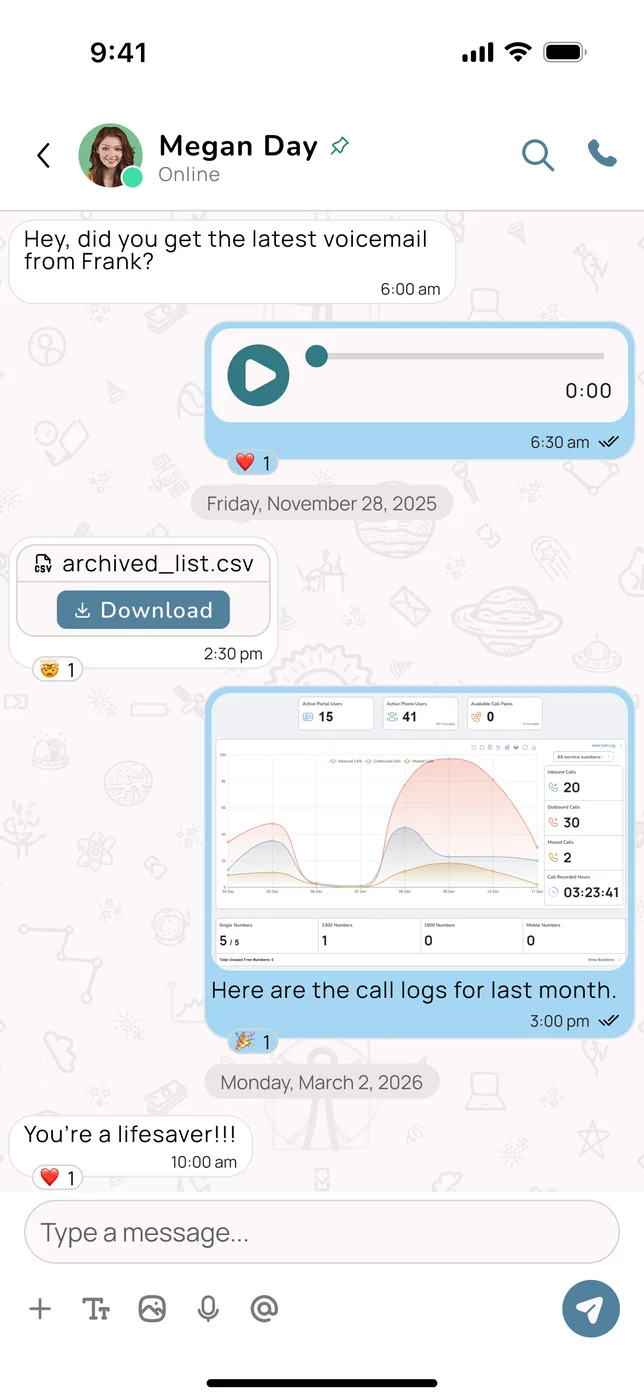
Studios run on attendance. A reminder the evening before, a "spot just opened" message to the waitlist and a confirmation after a tour booking all cut no-shows and save the desk a stack of calls. Two-way business SMS sent from the club's own number also means replies come back to the club, not to a casual's personal mobile.
Keep the content on the right side of the spam rules. ACMA says messages with no advertising, such as appointment reminders, are not spam. Purely factual messages do not need consent or an unsubscribe, but must still identify who sent them. Add an offer ("bring a friend free this week") and it becomes a marketing message that needs consent and a working unsubscribe.
| Message | Type | What it needs |
|---|---|---|
| "Reformer 6am tomorrow, see you at the Northside studio." | Factual reminder | Identify the studio. No unsubscribe needed. |
| "A spot opened in Thursday 6pm yoga. Reply YES to take it." | Factual, about a service they asked for | Identify the studio. Process replies quickly and fairly. |
| "Your freeze is confirmed from 1 Dec to 31 Dec." | Factual confirmation | Identify the studio. Keep a record. |
| "Summer challenge: 20% off a 10-class pack." | Marketing | Consent, sender identified, working unsubscribe. |
One more check: if your booking software sends texts under the studio's name rather than a phone number, that name is an alphanumeric sender ID. Since 1 July 2026 those must be registered on the ACMA's SMS Sender ID Register through each provider that sends them, or phones show "Unverified" instead of your name. Our Sender ID Register guide walks through it.
More Than One Club or Studio
Phone setups usually fall apart at the second or third site: separate lines, separate voicemail, and no idea how many calls each one misses.
A cloud system turns that around. Publish one number on the website and in the ads, then route behind it: by club, by time of day and by queue. A call to a flat-out club can overflow to a quieter one, each club keeps its own local number and greeting for its Google Business Profile, and reporting rolls up across all of them. With VOCPhone you can also run one AI agent per location, each with its own hours, its own knowledge and its own calendar, all managed from one portal.
- Franchise groups can set the rules centrally (how cancellations are handled, what the agent can and cannot say) while each franchisee sees their own calls.
- Clubs with different hours get different time rules, so the regional site that closes at 8pm hands over to the agent at 8pm, not when the city club does.
More detail on running many locations on one system is in nine locations, nine phone bills, no reports.
Connecting Your Membership Software
Most clubs run a membership and booking platform that already knows who every member is. The phone should use that, not sit beside it. VOCPhone connects to more than a thousand apps through an open API, webhooks and Zapier, and the AI agent has its own tools: a calendar tool to book, move and cancel bookings, a transfer tool to put callers through with context, and webhooks to push the outcome of each call into another system.
We do not advertise a ready-made connector for any particular gym platform, so the honest test is this: ask your membership software provider whether it has an open API, webhooks or a Zapier connection. If it does, a call can arrive with the member's name and status attached, a tour booked by the agent can appear in the right calendar, and a freeze or cancellation request can land as a task for the manager. If not, the agent can still email a summary of every call. Our open API guide shows what is possible.
Worked Example: A Two-Site Pilates Studio
The following is illustrative. It is a made-up business to show how the pieces fit, not a customer.
A reformer pilates business has a Northside and a Southside studio. Classes run 6am to 8pm on weekdays and mornings on weekends. Each studio has a front desk staffed for about four hours a day around the busiest classes; the rest of the time the instructor is teaching. The owner wants every enquiry answered and has had two complaints this year from members who said they could not get through to cancel.
- Numbers. Both studios port their existing local numbers across, and the 1300 number on the website comes too. Each studio's local number stays on its own Google Business Profile.
- Staffed hours. Calls ring that studio's desk handset and the desk app on a tablet. If nobody answers in about 20 seconds, the call overflows to the agent.
- Unstaffed hours. Vocky answers for each studio from that studio's timetable, price list and policies, books intro classes and tours into the calendar and texts a confirmation from the studio number.
- Freezes and cancellations. The agent takes the request, reads back the details, sends written confirmation and creates a task for the owner. It does not argue or apply pressure.
- Urgent calls. A member who cannot get in, or a fault at the studio, transfers to the owner's mobile. Everything else waits for the morning summary.
- Reminders. Factual class reminders and waitlist offers go out by SMS. Promotions go only to members who have opted in.
| Item | Illustrative setup | Price, from vocphone.com/pricing (16 Nov 2026) |
|---|---|---|
| Business phone plan | 4 users: two desks, the owner, a studio manager | $84.90 a month for 3 users on a 36-month term, plus $30 for the fourth user, so $114.90 a month |
| Setup and porting | Two local numbers and a 1300 number | $0 setup, $0 porting |
| Apps, queues, voicemail to email, business SMS | Included for every user | Included |
| AI phone agent | One agent per studio | Priced separately; ask us for a current quote |
Prefer no lock-in? The same plan is $104.90 a month month to month for three users. Prices are in AUD and include GST.
What to Ask Before You Choose
Whoever you buy from, ask these four questions.
What happens at 2am?
Ring the demo number out of hours. Does something useful answer, or does it go to voicemail?
Can a cancellation be confirmed in writing, every time?
Ask to see the record and the confirmation text the system sends.
Can each site keep its own number and hours?
And can you still see all of them in one report?
Who runs the network?
VOCPhone owns and operates its own network in Australia with 99.99% uptime. Many providers resell someone else's, which matters when you need a fault fixed.
Clubs including Gold's Gym already run on VOCPhone. If you would like to see how the three lanes would work for your club or studio, our local team will walk you through it, and our gyms page shows the AI agent handling a real-sounding membership enquiry after the desk has closed.
Frequently Asked Questions
What is the best phone system for a gym in Australia?
The best phone system for a gym is one designed around the hours nobody is at the desk. Look for a cloud phone system with desk and mobile apps, time-of-day routing, overflow when the desk is busy, an AI phone agent that can answer prices, timetables and tour bookings after hours, transfer of urgent calls to an on-call manager, two-way SMS from the club's own number, and recordings or transcripts so you can check what was said. For more than one club, it should route one published number to the right site and report across all of them.
Can an AI receptionist answer calls for a 24-hour gym?
Yes. An AI phone agent can answer overnight and at weekends using your timetable, price list and policies, book tours and trial classes into your calendar, take freeze and cancellation requests, send an SMS confirmation and leave a transcript and summary for staff. It should transfer urgent calls, such as a member who cannot get in or a problem in the club, to an on-call manager. It is not an emergency service, so members should always call Triple Zero (000) first if someone is hurt or in danger.
Can members cancel a gym membership over the phone?
That depends on your contract and the fitness code in your state. Queensland and Western Australia have mandatory fitness codes; WA's Consumer Protection says cancellations can be requested by a simple email, and NSW guidance tells members to cancel in writing so they can prove the date. From 1 July 2027 the Unfair Trading Practices Act will require an easy, straightforward way to cancel a subscription. If members can ring about cancelling, your phone system should accept the request, record the date and send written confirmation rather than turning them away.
What changes for gyms under the Unfair Trading Practices Act?
The Competition and Consumer Amendment (Unfair Trading Practices) Act 2026 received Royal Assent on 6 July 2026 and commences on 1 July 2027. Among other things it bans subscription traps. Businesses selling ongoing memberships will need to disclose that it is a subscription and how renewal and cancellation work, offer a straightforward and easy-to-find way to cancel using only reasonably necessary steps, provide an online option where the member signed up online, and send reminders at key points set by regulation. This is general information; check your contracts with an adviser.
Do gym class reminder texts need an unsubscribe option?
Not usually. ACMA says messages with no advertising, such as appointment reminders, are not spam, and purely factual messages do not need consent or an unsubscribe link, although they must still identify the sender. Once you add an offer or promotion the message becomes marketing and needs the member's consent and a working unsubscribe. If your texts show the studio's name instead of a phone number, that sender ID must be registered on the ACMA SMS Sender ID Register, or phones show it as Unverified.
How do gym franchises handle phones across multiple locations?
Most use one cloud phone system for every site. A single published number routes callers to the right club by location, time of day and queue, with overflow to a quieter club or to an AI agent when a desk is busy. Each club keeps its own local number and greeting for its Google Business Profile, rules such as how cancellations are handled are set centrally, and reporting rolls up so head office can see missed calls at every site. With VOCPhone you can run one AI agent per location, each with its own hours, knowledge and calendar.