

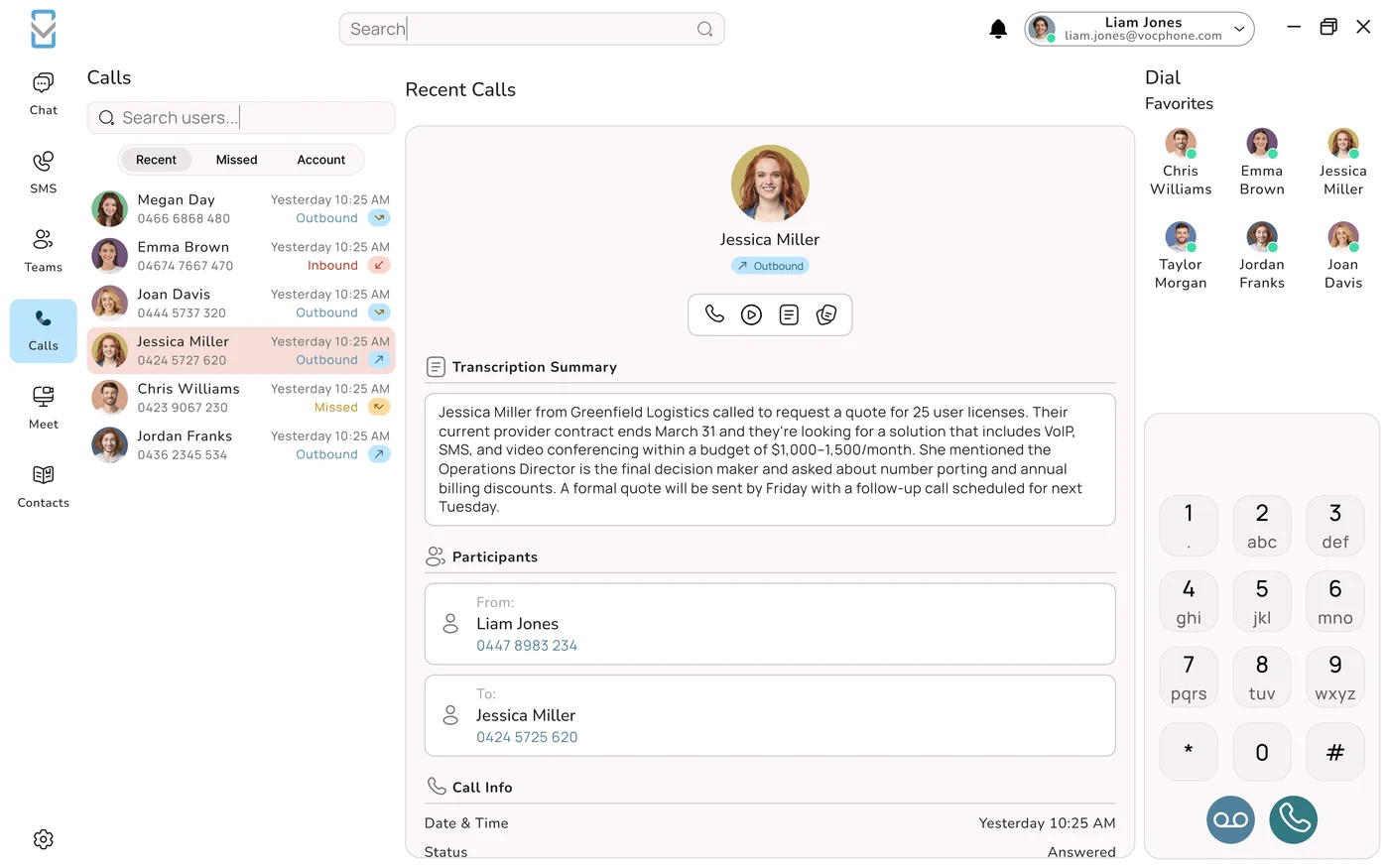










What "Business SMS" Really Means
Business SMS is text messaging sent and received from your business phone number rather than an employee's personal mobile. The text goes out under your business identity, replies come back to the business, and the whole conversation is logged in your phone system where the right people can see it, on a computer as well as a phone. It is the same green-bubble texting your customers already use every day, just wired into your business instead of someone's private handset.
The word doing the work is business. When a plumber texts an arrival time from their own mobile, the message technically arrives, but it is invisible to the office, gone the moment that person is on leave, and mixed in with their personal life. Business SMS fixes all of that by making the text a first-class part of your communications platform, exactly like a phone call. Anyone authorised can pick up the thread, the history is retained, and the customer only ever deals with your business number.
On a modern cloud phone system, business SMS can run on a few number types. Your existing landline or VoIP number can be text-enabled so customers reply to the same number they ring. Your 1300 or 1800 inbound number can carry outbound notifications and, increasingly, two-way replies. And many businesses add a dedicated mobile number specifically for conversational, back-and-forth texting. The point is that texting stops being a personal-phone workaround and becomes a proper business channel.
A channel, not another app
A decade ago, a business that wanted to text customers signed up for a standalone SMS "gateway", a separate service with its own login, its own bill and no link to the phone system. That still exists, and for pure bulk marketing blasts it has its place. But the modern approach folds texting into the same platform that already handles your calls. A missed call and the text you fire back to follow it up become part of one conversation, in one place. That integration is what turns SMS from a marketing tool into an everyday operational channel.
98%
approximate SMS open rate, versus roughly 20% for email
~90s
typical time to read a text after it arrives
1
business number for calls and texts, on desktop and mobile
99.99%
uptime on the network VOCPhone owns and runs
Open-rate and read-time figures are widely cited industry ranges, used here for illustration; your results will vary with your audience and message type.
Personal Phone vs Business Number
Because texting from a personal mobile is so easy, it is where most businesses start, and where a surprising number get stuck. It feels efficient in the moment but creates real problems that only surface later. Here is the honest comparison.
The trouble with texting from a personal phone
- The conversation is trapped on one device. If the customer replies while that staff member is off sick, on leave or driving, nobody else can see or answer it. Continuity depends on one person and one handset.
- It walks out the door. When an employee leaves, their phone, and every customer conversation on it, leaves with them. You lose the history and, sometimes, the relationship.
- It blurs work and personal life. Staff end up fielding customer texts at all hours on their private number, which is a wellbeing and boundary problem, and they are understandably reluctant to hand that number out.
- It creates privacy and record-keeping risk. Business conversations, and any consent or opt-out requests, sit outside your systems entirely, which makes compliance and record retention almost impossible to manage.
- It looks inconsistent. Customers get texts from a random mobile they do not recognise, rather than the business number they already have saved.
What business-number texting gives you instead
Texting from your business number, through your phone system, solves every one of those at once. Conversations are stored centrally and visible to whoever needs them. When someone is away, a colleague simply picks up the thread. Nothing lives on a personal device, so nothing leaves when a person does. Staff keep their private numbers private. And the customer always sees, and replies to, the one consistent business number, whether they are calling or texting.
A hidden compliance trap
If an employee texts customers from their personal phone, your business has almost no way to prove consent was obtained or that opt-out requests were honoured, both of which you are responsible for under the Spam Act 2003. Worse, if that person leaves and takes the records with them, you cannot even reconstruct what happened. Keeping business texting on your business number, inside your platform, is not just tidier; it is far safer.
Why a Text Beats a Call or an Email
Ask most people how they would rather hear that their car is ready, their appointment is tomorrow, or their delivery is running late, and the answer is a text. Texting suits the rhythm of modern life in a way that calls and emails often do not, and understanding why is the key to using it well.
It gets read, and read fast
The single biggest reason business SMS works is reach. Texts are opened at rates email cannot approach, usually within minutes. A phone call demands the recipient stop and answer in real time; an email may sit unread for hours or vanish into a spam folder. A text lands quietly, gets glanced at almost immediately, and can be dealt with on the customer's own schedule. For anything time-sensitive, that combination of reach and speed is unmatched.
It is low-friction and asynchronous
Texting does not force an interruption. A customer can reply while they are on the bus, between meetings or after hours, without having to be free for a conversation. That asynchronous quality kills the phone tag that plagues business calls, where two people leave each other voicemails for days. For a quick "yes, that time works" or "can you also quote the second bathroom?", a text is simply the path of least resistance.
It leaves a written record both sides trust
A phone call is gone the moment it ends, and memories of what was agreed drift apart. A text is a shared, timestamped record. When a customer confirms an appointment, approves a quote or sends an address by text, both parties have the same written reference. That cuts disputes, reduces "I never agreed to that" moments, and gives your team an accurate history to work from.
The shift in expectations
Younger and time-poor customers increasingly treat a business that cannot be texted as slightly behind the times. Offering a text option is moving from a nice touch to a baseline expectation, the way a mobile-friendly website did a decade ago. Businesses that make it easy to reach them by text tend to capture the enquiries a phone-only setup would lose.
The Texts That Earn Their Keep
Business SMS is not one thing; it is a toolkit. These are the applications where texting reliably saves time, wins work or reduces no-shows, and they are all supported from the same platform as your calls in VOCPhone.
Appointment Reminders
A text the day before cuts no-shows dramatically. Clinics, salons, trades and services recover hours of otherwise-wasted capacity by prompting customers to confirm or reschedule.
Quotes & Confirmations
Send a quote figure, booking confirmation or reference number the customer can keep and refer back to, no waiting for them to check email or answer a call.
Order & Delivery Updates
"Your order has shipped", "we're 30 minutes away", "ready for pickup". Proactive status texts cut inbound "where is it?" calls and keep customers relaxed.
Missed-Call Auto-Text
When a call goes unanswered, an automatic text fires straight back: "Sorry we missed you, reply here and we'll help." No enquiry falls through the cracks.
Review & Feedback Requests
A short text after a job, with a direct link, is the most effective way to collect Google reviews and feedback while the experience is still fresh.
Two-Way Support
Customers reply and get a real answer from a real person, threaded and visible to the whole team, so support does not hinge on catching someone by phone.
Missed-call auto-text: the quiet revenue saver
Of all these, missed-call auto-text deserves special attention. Every unanswered call is a potential customer who may simply ring your competitor next. An automatic text back, fired the instant a call goes unanswered, turns a lost call into a live conversation. The customer gets an immediate acknowledgement, can explain what they need in their own time, and your team picks it up when free. For busy trades and small teams who genuinely cannot always get to the phone, this one feature often pays for the whole platform, and it pairs neatly with an AI Phone Agent that can answer the calls you would otherwise miss entirely.
Appointment reminders: the no-show killer
No-shows are pure lost revenue, an empty chair, van or slot that cannot be resold at short notice. A reminder text a day out, ideally with a one-tap way to confirm or reschedule, gives customers the nudge and the escape hatch they need. Businesses that switch from phone-call reminders (which so often go to voicemail) to SMS reminders routinely see a meaningful drop in missed appointments, because the message actually gets read in time to act on.
The cheapest customer to win is the one who already tried to reach you. A text back the moment you miss their call is how you keep them from dialling the next number on the list.
Why VOCPhone builds SMS in beside your callsDesktop, Mobile & MMS: How It Works
Once texting is part of your phone system rather than a separate app, it works in ways a personal phone simply cannot match. Here is what that looks like day to day.
Texting from your desktop
This is the feature people underestimate until they use it. On a cloud phone system you send and receive business texts from a desktop app with a full keyboard, right next to your calls. Instead of pecking out replies on a phone, staff type quickly, paste in links and details, and keep conversations moving while they work at their computer. Common replies can be saved as templates, so confirming an appointment or sending directions takes one click. For anyone handling volume, desktop texting is a genuine productivity leap.
Texting from the mobile app
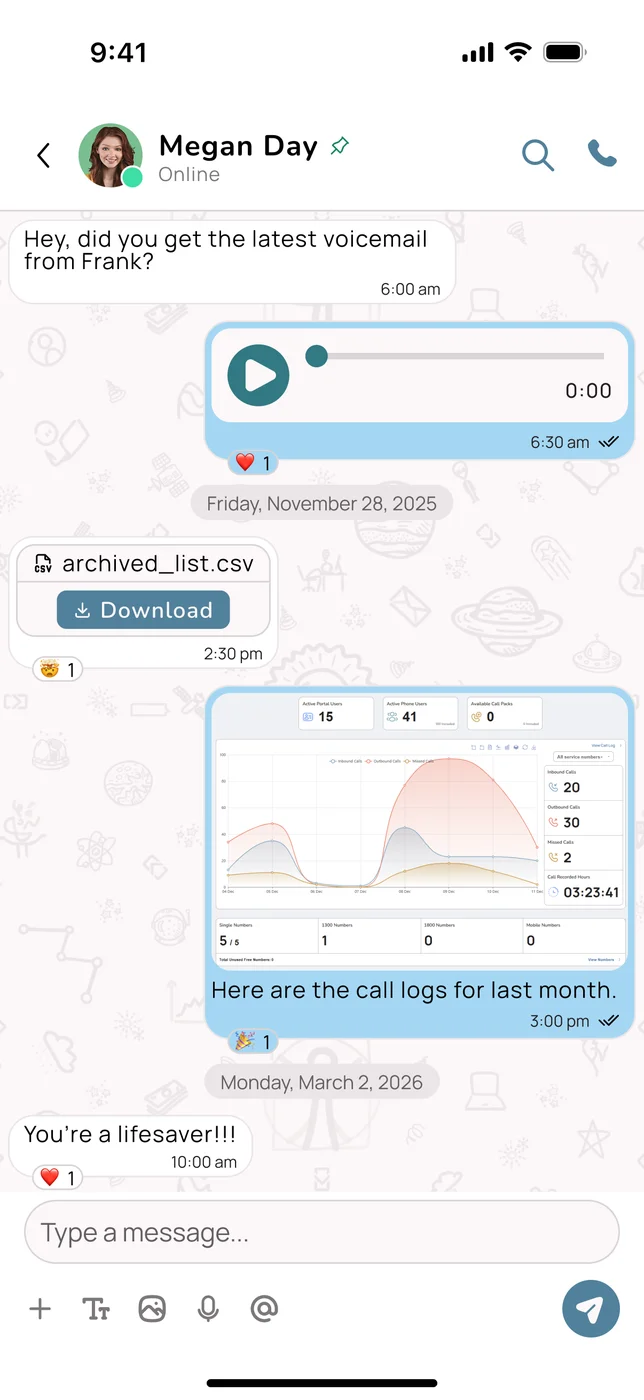
The same conversations are available in the mobile app, so a technician on-site or a manager between meetings picks up exactly where the desktop left off. Crucially, the texts still come from, and reply to, the business number, not the staff member's personal number. The business identity and the conversation history follow the app, not the device, which is exactly what keeps everything consistent and retained.
MMS: sending more than words
MMS (Multimedia Messaging Service) extends SMS to include images and richer content. In a business context that is genuinely useful: a trades business can send a photo of completed work or a part that needs replacing, a retailer can send an image of a product, and a service business can send a map or a marked-up diagram. Because it travels the same messaging channel, MMS lands with the same high open rates as SMS but carries far more than 160 characters allows.
SMS length, simply explained
A single SMS holds up to 160 characters. Longer messages are automatically split and reassembled on the recipient's phone so they read as one, though each segment may count as a separate message for billing. Keeping messages concise, with the important information first, is good practice: cheaper, clearer, and better suited to how people skim texts. When you need to send a picture or a longer visual, that is where MMS comes in.
Everything logged in one thread
Because the texts flow through your platform, every message is stored against the conversation and, where you have connected your CRM, against the customer's record. A colleague can open a thread and instantly see the full history, what was quoted, what was confirmed, what is outstanding, without asking around. That shared visibility is the difference between texting as a personal habit and texting as a business system.
Staying on the Right Side of the Spam Act 2003
Business texting is powerful, which is exactly why it is regulated. In Australia the rules for commercial messages, including SMS, are set primarily by the Spam Act 2003, administered by the Australian Communications and Media Authority (ACMA). Getting this right protects your business from penalties and, just as importantly, protects your reputation. Here are the three pillars in plain terms.
1. Consent
You generally need consent before sending a commercial message. Consent can be express (the customer actively opted in, for example by ticking a box or giving their number for updates) or, in limited cases, inferred from an existing business relationship where the message is relevant. Purely transactional messages a customer has effectively requested, such as a reminder for a booking they made, sit on much firmer ground than unsolicited marketing. When in doubt, get and record clear consent.
2. Identify your business
Every commercial message must clearly identify who sent it. The recipient should never have to guess which business a text came from. Sending from your recognised business number, and naming your business in the message where appropriate, satisfies this and also lifts response rates, because customers trust a message they can identify.
3. A working opt-out
Commercial messages must include a functional, low-cost or free way to unsubscribe, and you must honour opt-out requests promptly, within the short window the Act defines. A simple "reply STOP to opt out" is the standard approach. The opt-out has to actually work and be respected; ignoring it is one of the most common and costly compliance failures.
Sender ID and the STOP requirement
An alphanumeric sender ID (a business name instead of a number) can look professional, but messages sent from one cannot receive replies, which means the customer cannot simply reply STOP. If you use one, you must provide another clear opt-out method in the message. Two-way texting from your business number sidesteps this neatly: customers can reply, opt out and have a real conversation on the same number. For the detail on registering and using sender IDs, see our guide to the SMS Sender ID Register. This is general information, not legal advice, check your specific obligations with ACMA or a professional.
None of this should scare you off business SMS. The vast majority of everyday texting, reminders, confirmations and support replies to customers who contacted you, is entirely legitimate; the rules mainly exist to stop unsolicited spam. A platform that texts from your business number, keeps records and makes opt-outs easy keeps you comfortably on the right side of the line. VOCPhone is built to support that, though responsibility for obtaining and recording consent always rests with your business.
Three Ways Businesses Text, and Why Built-In Wins
There are three common ways a business ends up sending texts, and they are not equal. The table compares texting from a personal mobile, using a standalone SMS gateway, and having SMS built into your phone system (using VOCPhone as the built-in example).
| Capability | Personal mobile | Standalone SMS gateway | Built-in SMS (VOCPhone) |
|---|---|---|---|
| Sends from your business number | ✗ Personal number | ~ Sender ID varies | ✓ Your business number |
| Two-way replies to the same number | ✓ But on one phone | ~ Often one-way | ✓ Full two-way |
| Visible to the whole team | ✗ | ~ Separate login | ✓ Shared threads |
| Desktop + mobile apps | ✗ Phone only | ~ Web portal | ✓ All platforms |
| Sits alongside your calls | ✗ | ✗ Separate system | ✓ One platform |
| Missed-call auto-text | ✗ | ✗ | ✓ Built in |
| CRM & record integration | ✗ | ~ Some APIs | ✓ Salesforce, HubSpot, Xero+ |
| Consent & opt-out management | ✗ Manual | ~ Marketing-focused | ✓ Handled in platform |
| History survives staff turnover | ✗ Leaves with them | ✓ | ✓ Retained centrally |
| Separate vendor & bill | ~ Personal plan | ✗ Extra vendor | ✓ None, one bill |
| Runs on a network the provider owns | ~ Carrier's | ~ Varies | ✓ VOCPhone-owned |
The pattern is familiar. A personal mobile is free and instant but traps everything on one device with no records and no team access. A standalone gateway adds scale and retention but bolts on a separate system, login and bill, disconnected from your calls. Built-in SMS is the only option that keeps texting on your business number, visible to the team, connected to your calls and CRM, and under one bill, which is why it has become the sensible default for businesses that text customers regularly.
When SMS and Calls Live Together
The real magic of business SMS is not the texting itself, it is what happens when texting sits in the same platform as everything else. A text and a call to the same customer are two halves of one relationship, and treating them as one is where the efficiency comes from.
Picture a typical sequence. A customer rings; nobody is free, so the system fires a missed-call auto-text. The customer replies with their question. A staff member picks up the thread on their desktop, answers and books a job. A reminder text goes out the day before. Once the work is done, a review-request text lands with a link. Every touchpoint, the call, the texts, the booking, lives in one system, on your business number, visible to the team and captured against the customer's record. There is no jumping between a phone app, a separate SMS portal and a spreadsheet.
This is the same logic behind unified communications (UCaaS) generally: voice, video, messaging and SMS on one platform beat four disconnected tools every time. It is also why consolidating channels with a single provider tends to cost less and cause fewer headaches than stitching together a phone line here and an SMS gateway there.
Why "built in" beats "bolted on"
One number: customers call and text the same business number and reach the same team.
One history: calls and texts sit in one timeline, so anyone can see the full story of a customer.
One bill, no gateway: no separate SMS vendor to manage or pay. With VOCPhone, business SMS is part of the platform, on a network VOCPhone owns and operates, backed by 99.99% uptime.
Business SMS on VOCPhone
Plenty of tools can send a text. Very few put business SMS, your calls and AI on one genuinely Australian platform running on a network the provider owns. Here is what makes VOCPhone a strong home for business texting.
SMS Built Into the Platform
Text from your business number on the same platform as your calls, video and messaging. No separate SMS gateway, no extra vendor, no disconnected portal.
Desktop & Mobile Apps
Free apps for Windows, Mac, iOS and Android. Send and receive with a full keyboard at your desk, or on the go, always from your business number.
Missed-Call Auto-Text
Turn missed calls into live conversations automatically, so no enquiry is ever lost just because the phone rang at a busy moment.
On a Network We Own
Australian-owned and hosted, running on VOCPhone's own network rather than a reseller's, so your messaging data stays onshore and reliable.
Integrations That Matter
Native connections to Salesforce, HubSpot, Zoho, Xero, Monday and 1000+ apps, so texts attach to the right customer record.
Included, Not an Add-On
Simple per-seat pricing with AI Phone Agents included, number portability, unlimited calls on plan, and a price guarantee against genuine competitor quotes.
The practical upshot: with VOCPhone your team texts customers from your business number, on any device, with every conversation logged and shared, and it all sits beside your calls under one simple bill. Add AI Phone Agents that answer and route calls in natural Australian accents, plus 24/7 Australian-based support, and you have a complete customer-communication system rather than a patchwork of apps. It is the platform trusted by businesses from Harvey Norman and Ampol to smaller local operators like Coco's Wealth of Health.
Getting Started With Business Texting
Adding business SMS to your operation is quick, especially when it comes as part of a phone system you are already setting up or switching to. Here is the path from where you are today to your first business text.
-
Book a walkthrough
Talk to the team via contact us or on 1300 663 222. You will see business SMS working alongside calls, missed-call auto-text, appointment reminders and the desktop and mobile apps, tailored to how your business actually runs.
-
Choose your numbers and seats
Decide which numbers to text-enable, your existing landline or VoIP number, a 1300 or 1800 number, or a dedicated mobile for conversational texting, and how many seats you need.
-
Port your existing numbers
Keep the numbers your customers already know. VOCPhone handles the porting, and your old service stays live until it completes, so there is no downtime and your text-enabled numbers are ready when you go live.
-
Set up templates, auto-text and consent
Create templates for common messages (reminders, confirmations, review requests), switch on missed-call auto-text, and put a simple opt-out such as "reply STOP" on marketing messages. The onboarding team helps configure this and connect your CRM so texts land against the right records.
-
Go live on desktop and mobile
Install the free apps on your computers and phones and start texting customers from your business number straight away, no separate gateway to buy, no personal phones involved. The Australian team monitors the first few weeks to make sure everything runs smoothly.
Frequently Asked Questions
What is business SMS?
Business SMS is text messaging sent and received from your business number, your landline, 1300 or 1800 number, or a dedicated mobile, rather than from a staff member's personal phone. It runs through your phone system, so texts are logged, shared across the team and available on desktop as well as mobile. Customers see your business identity, replies come back to the business rather than one person's private phone, and the texts sit alongside your calls. With VOCPhone, business SMS is built into the same platform as your calls, with no separate SMS gateway to buy.
Can you send a text from a landline or 1300 number?
Yes. On a modern cloud phone system your landline, 1300 or 1800 number can be enabled to send and receive SMS. The number is text-enabled in software, so customers reply to the same number they call, and staff send and receive those texts from a desktop or mobile app. Many businesses also add a dedicated mobile number for two-way conversational texting. With VOCPhone, texting from your business number is part of the platform rather than a separate service you bolt on.
Why text from a business number instead of a personal phone?
Texting from a personal phone traps the conversation on one device, hides it from the rest of the team, loses it when that person is away or leaves, and mixes work in with their private messages. It also blurs work and personal life and creates privacy and record-keeping risk. Texting from your business number keeps every conversation logged in one place, visible to whoever needs it, professional in appearance, and aligned with your consent and opt-out obligations. VOCPhone keeps all business texting on your business number, on desktop and mobile, so nothing lives on a personal handset.
What are the main uses of business SMS?
The highest-value uses are appointment reminders that cut no-shows, quotes and confirmations, order and delivery updates, missed-call auto-text so no enquiry goes unanswered, review and feedback requests, and two-way support where people reply and get a real answer. Because texts are opened far more reliably and faster than email, SMS suits anything time-sensitive. VOCPhone supports all of these from the same platform as your calls, including automatic replies to missed calls.
Do I need consent to send business SMS in Australia?
Yes. Under the Spam Act 2003, commercial electronic messages including SMS generally require consent (express, or in limited cases inferred from an existing relationship), must clearly identify the sender, and must include a functional, free opt-out. Transactional messages a customer has effectively asked for, such as a reminder for a booking they made, sit on firmer ground than marketing broadcasts, but you should still honour opt-outs. VOCPhone makes it straightforward to identify your business and manage opt-outs, but responsibility for consent rests with your business, so keep records of how you obtained it.
Can I send business texts from my computer, not just a phone?
Yes. A key advantage of business SMS on a cloud phone system is that you send and receive texts from a desktop app with a full keyboard, alongside your calls, as well as from the mobile app. Staff handle text conversations while working at their computer, use templates for common replies, and hand a conversation between team members without anyone digging out a phone. VOCPhone provides free apps for Windows, Mac, iOS and Android, so texting works wherever your team is.
Does business SMS cost extra with VOCPhone?
Business SMS is built into the VOCPhone platform rather than requiring a separate SMS gateway, third-party app or extra vendor. Texting from your business number sits alongside your calls, video and messaging under one simple per-seat price, on a network VOCPhone owns and operates, with AI Phone Agents included, number portability and a price guarantee. For exact message allowances for your usage, speak to the team on 1300 663 222.
What to Read Next
This guide covers business SMS. These related articles go deeper into the phone system SMS lives on, from unified communications to choosing the right setup for your industry, and the sender-ID rules you need to know.