











4:52pm on a Friday
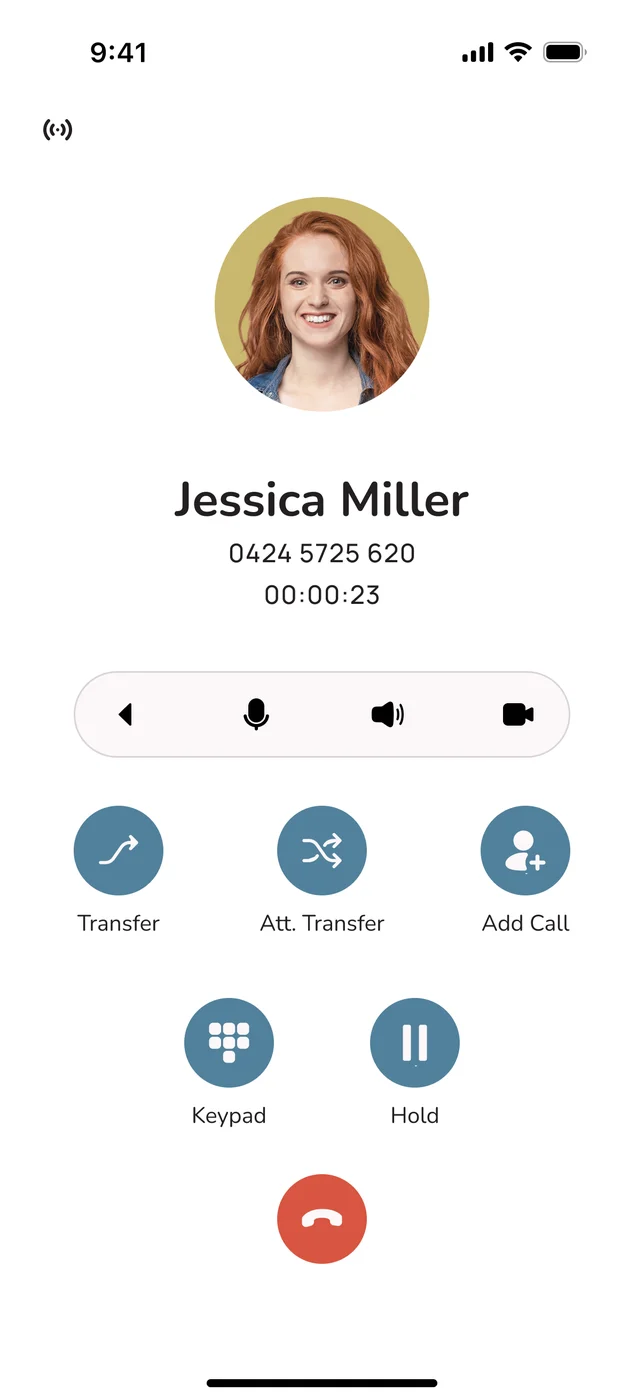
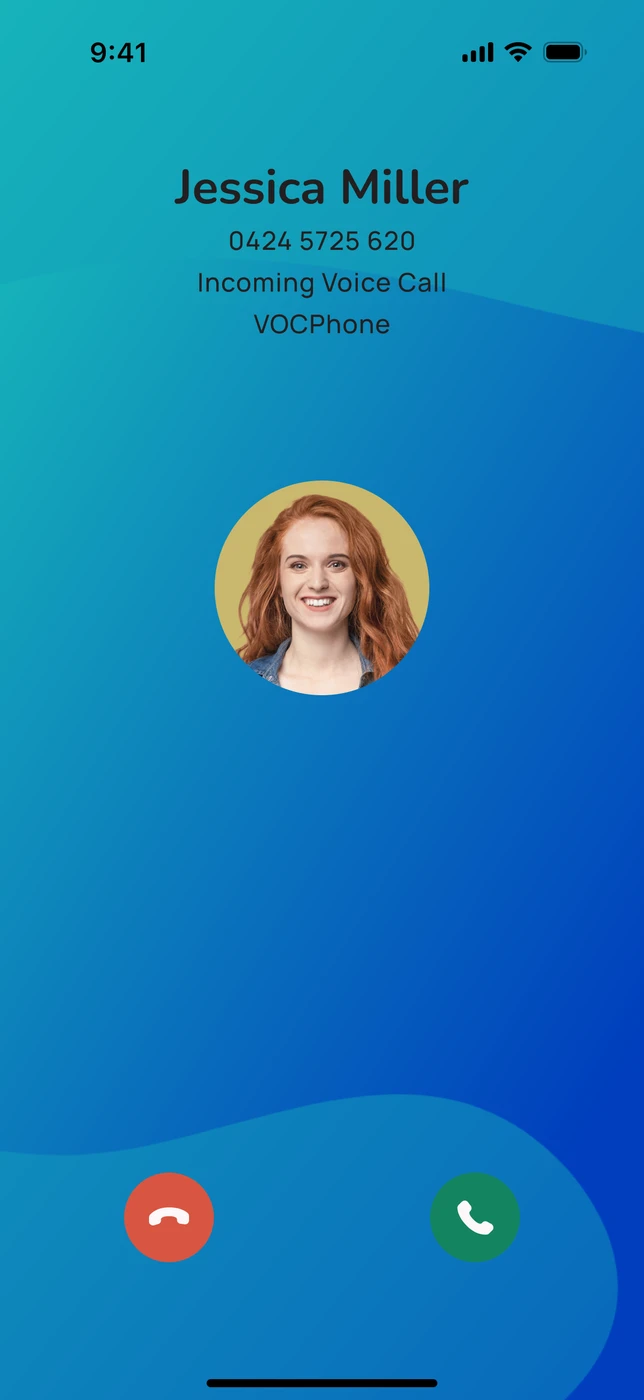
Your bookkeeper's phone rings eight minutes before she was going to shut the laptop. It's you. Not someone claiming to be you: you, with your cadence, the way you clear your throat before bad news, the slight rise you put on the end of a question.
You're at the airport. The deposit on the Dandenong site has to land before close of business or the vendor moves to the second offer. You've forwarded the details. You know it's not the usual process and you're sorry, and you'll sign whatever needs signing on Monday. There's boarding announcement noise behind you.
She pays it. And every instinct she used to make that decision was, until about two years ago, sound professional judgement.
That's the scenario worth sitting with for a moment, because the interesting question isn't "how do we spot that". It's "why was there a process in which recognising a voice was sufficient?" and the answer is that for a century it was, so nobody ever wrote it down as a control, which meant nobody noticed when it stopped working.
The Control That Died Without a Memo
Voice synthesis has reached what security researchers describe as the indistinguishable threshold: the point at which human listeners can no longer dependably tell a cloned voice from a real one. Over a phone line, which discards a large slice of the audio spectrum that might have given a clone away, and under manufactured urgency, it isn't close.
The samples required are trivially available. Published reporting through 2025 and 2026 describes usable clones from seconds of clean audio: a webinar, a company video, a podcast, a conference talk, a radio grab, or your own after-hours voicemail greeting saying your name.
Seconds
Of audio reportedly enough to produce a convincing clone
442%
Reported surge in voice phishing through 2025, attributed to AI techniques
0
Reliable ways for staff to detect a good clone by ear on a phone line
1
Control that still stops nearly all of it: call back on a number you already hold
About those figures
The percentages come from published industry and vendor reporting on 2025 to 2026 attack volumes, not from our own measurement, and different sources count these incidents differently. Read them as direction rather than precision. The direction isn't disputed by anyone, and every control below is worth adopting whether the real number is 100% or 500%.
Why Your Best People Are the Target
It's worth saying plainly: the people who fall for this are not careless. The attack is engineered against three things that have nothing to do with competence.
Hierarchy. Challenging a director costs something socially that challenging a stranger doesn't. Most workplaces have accidentally trained people that senior requests get actioned rather than interrogated, and the more conscientious the employee, the more reliably that training holds.
Urgency. Every pretext supplies a reason the normal process can't be followed right now. Urgency exists precisely to remove the pause in which a person would otherwise think, check, or walk down the corridor and ask.
Isolation. The call lands when the person who'd normally be consulted is unreachable. After hours. Mid-meeting. The Friday before a long weekend. The staff member is manoeuvred into deciding alone, which is not how they'd ever choose to decide.
"If it feels awkward for your bookkeeper to say 'I'll ring you back on the number I've got' to the managing director, then the culture is the vulnerability, and no security product on earth patches that."
the uncomfortable part of every VOCPhone security conversationThe Four Plays
Four patterns account for the overwhelming majority of what Australian businesses are actually seeing.
| Play | How it runs | Why it lands | The control that stops it |
|---|---|---|---|
| Executive impersonation | Cloned owner or director rings finance with an urgent payment that must bypass approval | Hierarchy plus urgency; often aimed at a junior rather than the CFO | Callback to a held number + dual authorisation |
| IT helpdesk impersonation | "Support" walks a staff member through a password reset, an MFA approval, or remote access | Staff are trained to comply with IT quickly and without fuss | Absolute rule: never approve codes or credentials by voice |
| Supplier bank-detail change | A familiar supplier contact advises new account details before an invoice falls due | Looks like routine admin, not an emergency, so it triggers no alarm | Bank changes verified by callback, actioned by a second person |
| Customer impersonation | Cloned customer asks your staff for an address change, account detail, refund redirect or goods release | Your team is trained to be helpful: that's the vulnerability | Verification steps on outbound-facing changes too |
The fourth play is the one businesses reliably overlook, because security thinking runs inward, protecting the company from external instruction, rather than outward. If a staff member can change a delivery address, release stock or reset a customer's access on a phone call, that process needs verification as much as your payment run does.
The Advice You Should Stop Giving
A great deal of awareness material still tells people to listen for flat intonation, odd pauses, missing breath sounds or robotic artefacts. That was defensible in 2023. In 2026 it's not just obsolete: it's counterproductive, and the mechanism matters.
Someone trained to listen for tells will listen for tells. When they hear none, which with current synthesis over a phone line is the likely result, they'll conclude the call is genuine. The training hasn't protected them; it has manufactured the confidence that removes the doubt which might otherwise have produced a callback. Detection training converts a hesitant employee into a certain one, in the wrong direction.
The replacement framing is far easier to teach and needs no expertise: it does not matter whether the voice is real. Any request that moves money, changes payment details, resets credentials or skips an approval gets verified out-of-band, every single time, however convincing the caller is. No judgement, no audio analysis, no courage required.
The Verification Ladder
Rather than a flat list of tips, think of it as a ladder: each rung independent of whether anyone can spot a fake.
Rung 1: Call back on a held number
Hang up. Ring the person on the number already in your records. Never one the caller supplies, never a reply on the same channel. This works because the attacker owns the inbound call and not your contact list. Applies to everyone, owner included.
Rung 2: Confirm out-of-band
Confirm on a channel the caller didn't choose: a message to a known mobile, a Teams message to their account, a walk to their desk. Two contacts on channels the attacker controls is not corroboration, however much it feels like it.
Rung 3: Two approvers above a threshold
Any payment over an amount you set needs two named people. This is why well-run finance functions rarely lose money this way: no single pressured individual is ever the whole control.
Rung 4: A standing rule on bank changes
Supplier account details are never changed on the strength of a call or an email. Always callback to a pre-existing number, always actioned by someone other than whoever took the request.
Rung 5: A shared passphrase
Deeply low-tech, remarkably effective. A word known to leadership and finance, never written in email, for the rare genuine emergency that must go by phone. A perfect clone of your voice still doesn't have it.
Rung 6: Never voice-approve credentials
Absolute: no legitimate IT team, bank, provider or telco will ever ask a staff member to read out a code or approve a prompt mid-call. "No exceptions" means nobody has to make a judgement call.
If you do one thing this week
Send four sentences to everyone, from you: "Any request to move money, change bank details, reset a password or skip an approval must be verified by ringing the person back on the number already in our systems. This includes requests that appear to come from me. You will never be criticised for doing it. If in doubt, do it." That message is worth more than any product, including ours.
What Your Phone Platform Can and Can't Do
Let's be straight about this, because there's a lot of security marketing that overstates it. No phone system reliably detects a cloned voice. What a good platform changes is what you can do afterwards, and how fast, and every item below only works if it was already on.
| Capability | What it actually buys you | Why it must be on beforehand |
|---|---|---|
| Call recording | Turns "I think he said…" into an artefact your bank, insurer and investigators can act on | You cannot retrospectively record a call that already happened |
| AI transcription & search | Reveals whether the same pretext hit three other staff: campaign vs incident | Untranscribed audio is effectively unsearchable at volume |
| Centralised screening & blocking | Block or flag a hostile number business-wide in one change | Per-handset blocking doesn't scale during a live campaign |
| Verified outbound identity | Makes your brand harder to weaponise against your own customers | Sender ID registration isn't an emergency lever |
| Onshore data | Evidence stays under the Privacy Act rather than in a jurisdiction you reason about mid-incident | Hosting location is decided at signup, not at 5pm on a Friday |
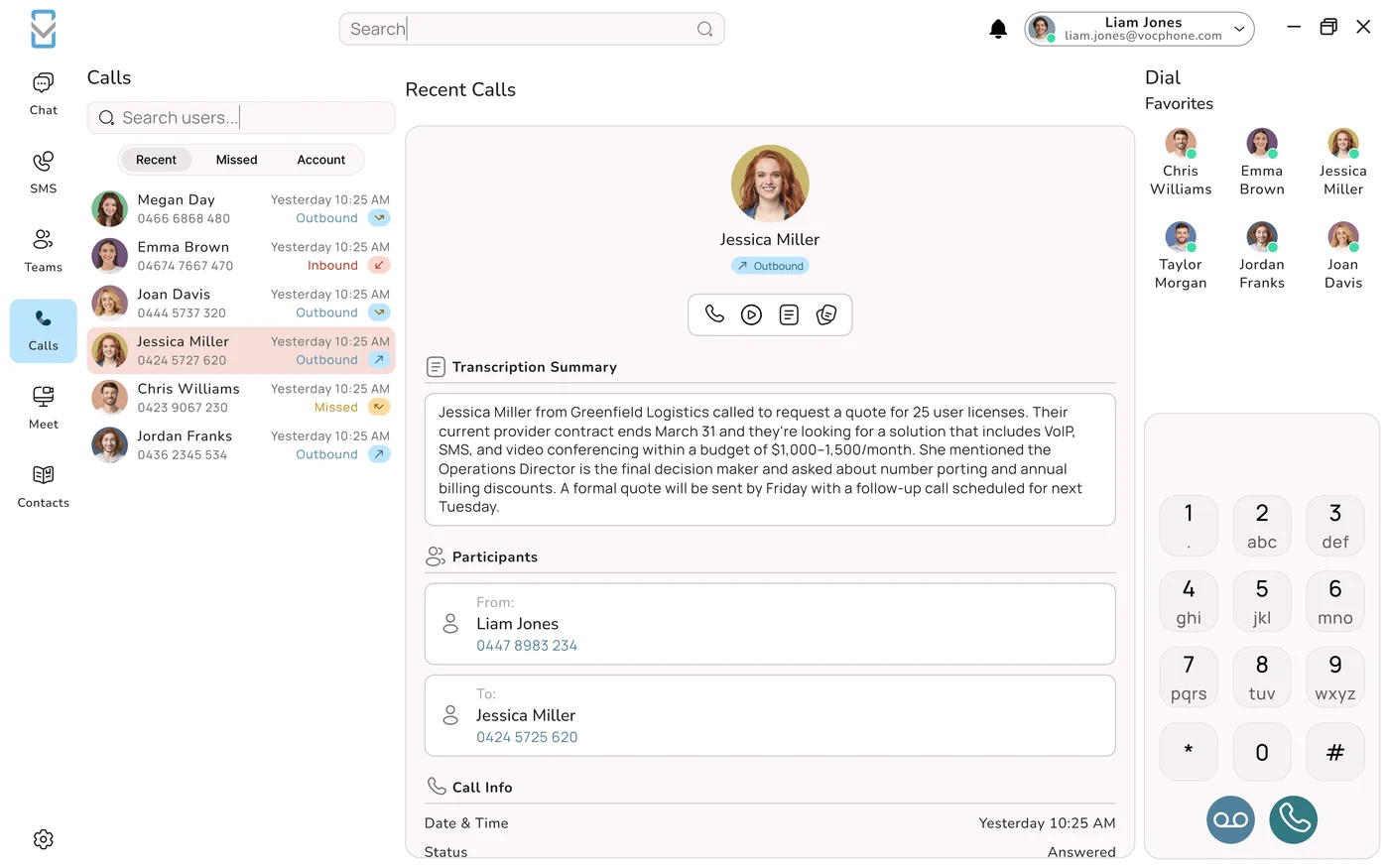
VOCPhone includes recording, AI transcription and centralised call controls with the platform rather than as a security add-on, on Australian infrastructure, on a network we own and operate ourselves. See AI call transcription and CRM notes for how the searchable-transcript side works.
The one thing to stop relying on
Caller ID is not identity. A displayed number is metadata and can be manipulated. Any process whose verification step is "the number matched" has no verification step at all. Say this to your team out loud, because a matching number is precisely the corroborating detail that convinces a careful person to proceed.
The Other Direction: When You're the One Impersonated
Everything above concerns calls coming in. There's a second exposure that gets far less attention and can do more reputational damage: scammers impersonating you to your own customers.
If someone can ring your customers claiming to be your accounts team, or text them from something that resembles your brand, the harm lands on your name regardless of fault. Australia has tightened here and the practical steps aren't hard.
Register your sender identity so your messages arrive attributed rather than flagged as unverified: the mechanics are in the SMS Sender ID Register guide. Publish, plainly, what you will and won't ever ask for by phone. And keep that message consistent across your website, your invoices and your messages, because a customer who has been told "we will never ask you to read out a code" has a rule to fall back on that survives a convincing voice.
The First Hour
Print it. Stick it somewhere findable. The order matters: two of these decay by the minute.
If money moved, ring the bank. Now.
Before any internal discussion or working out what happened. Recall prospects fall away by the hour and nothing else here is time-critical in the same way.
Preserve everything
Recording, transcript, number, exact time, what was said, and any email or text that came with it. Delete nothing, including anything that feels embarrassing.
Check who else was approached
Search your transcripts and ask the team directly. These are campaigns far more often than single calls, and a second attempt may still be running.
Reset anything discussed
Credentials, access, approvals, even if you're confident nothing was disclosed. Cheap, fast, removes a lingering unknown.
Report it
Scamwatch, ReportCyber if there's a cyber element, and your insurer within their notification window, often shorter than businesses expect, and lateness can affect a claim.
Review without blame
The step that decides whether you hear about the next one. Fear of consequences delays reporting, and delay is what turns a contained incident into a loss.
Six Lines You Can Send Today
You don't need a consultant for this. Six lines covers the vast majority of realistic attacks. Adjust the amount, circulate it, and mean it.
Voice request verification: draft policy
1. Any phone request to move money, change bank or payment details, reset credentials, approve a multi-factor prompt or bypass an approval must be verified by calling the requester back on a number already held in our systems.
2. Numbers supplied by the caller are never used for verification, and neither is a reply on the same channel.
3. This applies to requests appearing to come from directors, owners and managers. There is no seniority exemption.
4. Payments above $[amount] require authorisation by two named people.
5. Supplier bank-detail changes are verified by callback and actioned by someone other than the person who received the request.
6. No staff member will ever be criticised, formally or informally, for applying this policy. Following it is doing the job correctly.
Line six isn't padding. It's the line that determines whether the other five ever get used.
Regulation Is the Floor
Australia has moved faster than most jurisdictions on scam prevention, and it genuinely helps: inside limits worth understanding.
Providers now carry real obligations to prevent, detect, disrupt and report scam activity, and network-level blocking of high-volume scam traffic has improved materially. Sender ID registration has made SMS impersonation of businesses considerably harder. The wider shift toward provider accountability is covered in the new telco transparency rules.
What none of it does is stop one well-researched call to your finance manager. Network controls are powerful against volume and structurally weak against a single targeted attempt, which is exactly why voice cloning is pointed there. Regulation lowers the noise reaching your staff. Your verification rules stop the attack that was built for you.
The honest summary
Regulation is the floor. Callback verification, dual authorisation and a culture where verifying the boss is expected are the walls. Recording and transcription are how you prove what happened. Nobody gets to skip the middle one, and no vendor, including us, can sell it to you.
Frequently Asked Questions
Is my voice already out there for someone to clone?
Almost certainly, if you have ever recorded a voicemail greeting, appeared in a company video, spoken on a webinar or podcast, been interviewed, or presented at anything. Reporting through 2025 and 2026 consistently describes usable clones being built from very short samples, on the order of seconds of clean audio. An attacker can simply ring your desk after hours and record your own voicemail greeting saying your name. There is no useful strategy in trying to remove your voice from the world, and attempting it would mean giving up most normal business communication. Accept that the audio is available and put the defence in your processes instead, because that is the part you can actually control.
Shouldn't we train staff to recognise a fake voice?
No, and this is the advice most worth reversing. Reporting through 2026 describes voice synthesis as having crossed the point where human listeners can no longer reliably distinguish real from synthetic, especially across a phone line that strips out much of the audio spectrum and under the time pressure attackers deliberately manufacture. The problem with detection training is not just that it fails, it is that it fails in the worst possible direction: a staff member who listens carefully for the tells they were taught, hears none, and concludes the call is genuine has been handed false confidence. Train the process instead. It does not matter whether the voice is real, because the verification step is identical either way, and that removes the need for anyone to make an audio judgement under pressure.
What is the one control that stops most of this?
Ring back on a number you already hold. Any request that moves money, changes bank or payment details, resets credentials or skips an approval gets verified by hanging up and calling the person on the number already in your own records, never one the caller provides and never by replying on the same channel. It works because it sidesteps detection entirely: the attacker controls the inbound call but has no access to your contact list. Two details make or break it in practice. It has to apply to everyone including the owner, with no seniority exemption. And it has to be stated in writing that nobody will ever be criticised for using it, because the reason this control fails is almost never ignorance, it is a junior staff member feeling unable to challenge a director.
Can we trust caller ID to confirm who is calling?
No. A displayed number is metadata, not authentication, and it can be manipulated. This matters more than it sounds because a matching number is exactly the sort of corroborating detail that persuades an otherwise careful person to proceed, and attackers know it. Say it to your team explicitly: the number matching is not verification. The same logic applies to a second contact arriving by email or text shortly after the call, which feels like independent confirmation and usually is not, because an attacker running the call is frequently running the email too. Genuine verification means a channel the caller did not choose, reaching a destination the caller did not supply.
How does a cloud phone system help with this?
Not by detecting fakes, which nothing reliably does, but by changing what you can do afterwards and how fast. Call recording turns a contested memory into an artefact your bank, insurer and investigators can act on. AI transcription makes calls searchable, which is how you find out whether the same pretext was tried on three other staff and therefore whether you are facing a campaign rather than an incident. Centralised number screening lets you block or flag a hostile number across the entire business in one change instead of device by device. And verified outbound business identity reduces the chance of your brand being used against your own customers. VOCPhone includes recording, AI transcription and centralised call controls with the platform, on Australian infrastructure, so the resulting evidence stays onshore. The catch is that all of it has to be switched on before the incident, not after.
What do we do in the first hour if we think it has happened?
Bank first, before any internal discussion, if money has moved at all: recall prospects decay by the hour and nothing else on this list is time-critical in the same way. Then preserve evidence: recording, transcript, number, exact time, and any email or text that accompanied it, including anything that feels embarrassing. Then check whether other staff were approached, because these are usually campaigns and a second attempt may still be live. Then reset any credentials that were discussed, even if you are confident nothing was given away. Then report to Scamwatch, to ReportCyber if there is a cyber element, and to your insurer inside their notification window, which is often shorter than businesses expect. Then review it without blaming the person who took the call, because fear of consequences delays reporting and delayed reporting is what turns a contained incident into a loss.
Doesn't Australian regulation already block scam calls?
It blocks a lot of them, and that genuinely helps. Australian providers now carry real obligations to prevent, detect, disrupt and report scam activity, and sender identity registration has made SMS impersonation of businesses considerably harder. What regulation cannot do is stop one well-researched call to your finance manager. Network-level controls are powerful against mass campaigns and structurally weak against a single targeted call, which is exactly why voice-cloning fraud is aimed there rather than at volume. The sensible framing is that regulation is the floor: it lowers the amount of noise reaching your staff. Your internal verification rules are the walls, and they are what stops the attack that was actually built for you.