

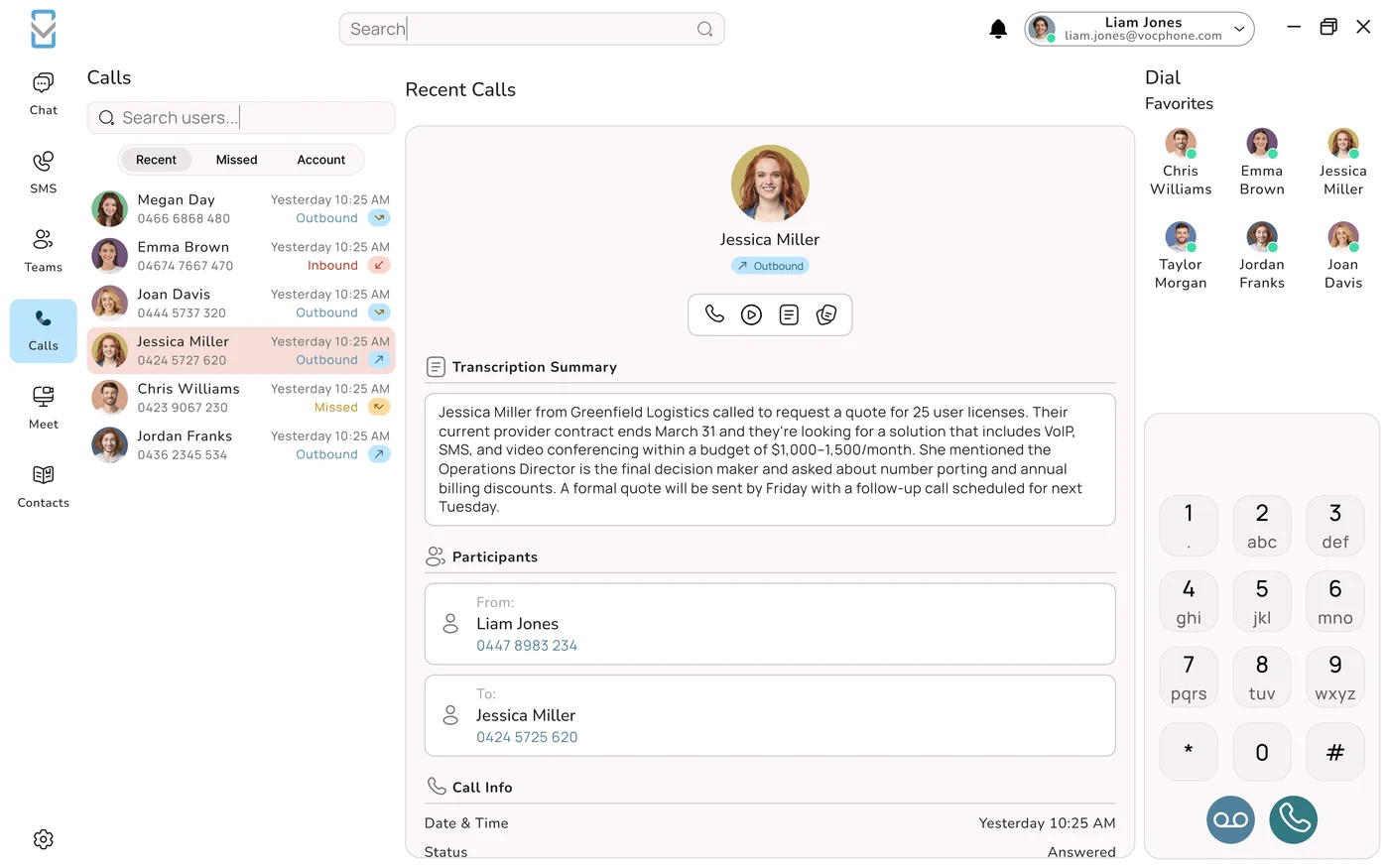
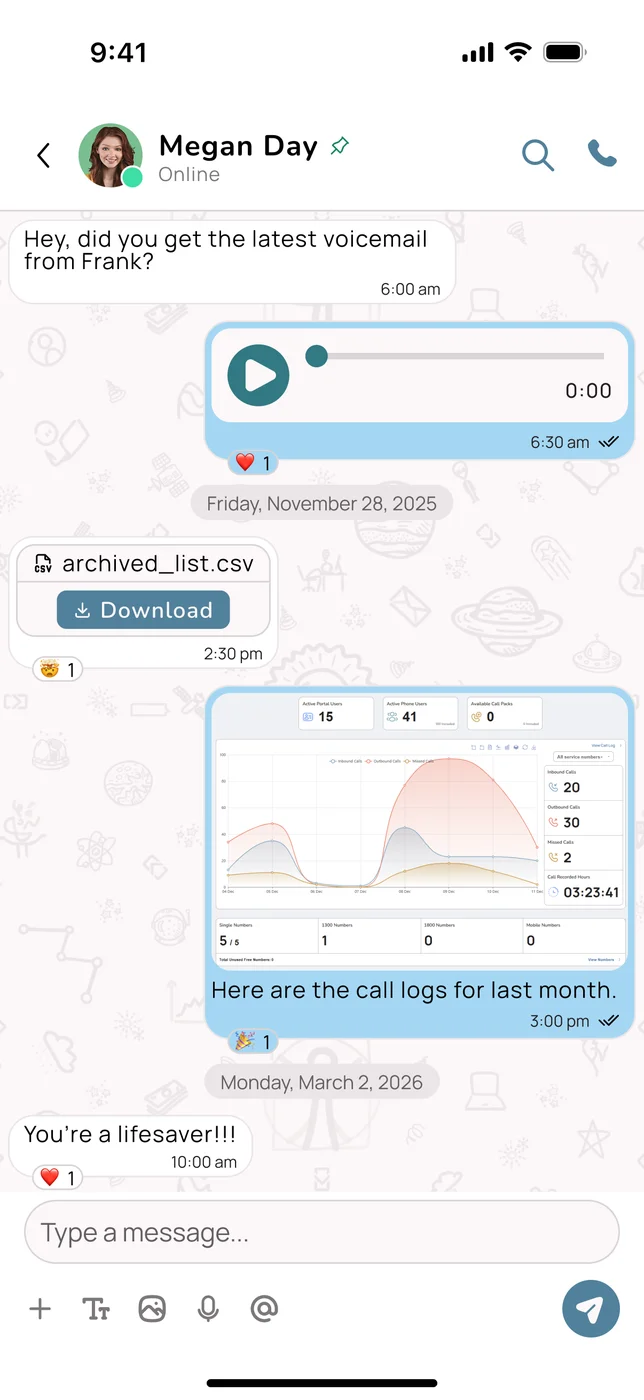










The Week, Broken Down
Take the five contacts from the same customer and look at what each one produced.
| Day | Channel | What it created | What was lost |
|---|---|---|---|
| Tuesday | Web form | A lead in the CRM and an email to somebody. | Nothing yet, though the clock started and nobody is watching it. |
| Wednesday | Phone call | A line in the call log. Details on a pad. | The connection to Tuesday's lead, the content of the conversation, and any record that a promise was made. |
| Thursday | SMS to a mobile | A message on one person's handset. | Everything. It exists in no system, it is not searchable, and if that person is away it is invisible. |
| Friday | A conversation in an app on a phone. | The link to the same customer, and any chance of somebody else picking it up. | |
| Tuesday | Phone call | An unhappy customer and a scramble. | The customer, about forty per cent of the time, and you will never know which forty. |
Notice that no individual system failed. The CRM stored the lead correctly. The phone system logged the call. The mobile delivered the text. The messaging app showed the message. Every component did its job, and the customer still had five conversations with a business that behaved as though it had never met them.
Applications fail at the joins, and the joins are where nobody is looking, because no vendor is responsible for them. Every software review you will ever read evaluates applications. Nothing evaluates the space between them, which is where most of the customer experience actually happens and where essentially all of the avoidable loss occurs.
Where Stacks Actually Fail
Four specific breaks account for most of it, and they are the same four in nearly every business we look at.
The channel break. A customer who switches channel becomes a new customer, because nothing links the form, the call, the text and the message. This is the most common and the most expensive, and it has become worse rather than better as businesses added channels to be helpful.
The record break. Voice is the majority of customer contact in most Australian businesses under two hundred people, and almost none of it reaches the customer record beyond a timestamp. That means the largest single body of information you hold about your own customers is unusable by anything, including any AI you have bought.
The action break. Something is agreed on a call, and the follow-up depends on somebody remembering to create it. Most do, most of the time, which is exactly the failure rate that produces a steady leak nobody can see.
The ownership break. A message arrives somewhere that belongs to one person rather than to the business: a mobile, an inbox, an app. The business now has a dependency on an individual's attention, and no way to know what it has missed.
Why This Ends in a Hub
There are only two ways to join systems together, and the arithmetic settles which one scales.
| Systems in the business | Connections if joined directly | Connections through a hub |
|---|---|---|
| 4 | 6 | 4 |
| 6 | 15 | 6 |
| 9 | 36 | 9 |
| 12 | 66 | 12 |
Most Australian businesses between ten and two hundred people run nine to fourteen pieces of software. Nobody builds thirty-six integrations. They build five or six, usually the obvious ones, and the remaining thirty are paid for in staff time: somebody retyping, somebody checking two screens, somebody asking a colleague whether this customer has been called. That labour never appears as an integration cost in any budget, which is precisely why the problem persists.
A hub changes the shape. Every application connects once, to the middle, and the middle carries the mapping between them. The maintenance burden drops from a number that grows with the square of your software count to one that grows in a straight line. This is not new thinking, it is how integration has worked in large organisations for decades. The only genuinely open question for a smaller business is which layer plays the middle, given that nobody is going to run an integration team. We looked at the consolidation version of this question in nine suppliers, one office.
What Belongs in the Middle
Four properties decide it, and the communications platform is the only layer in a typical stack that has all four.
Intent arrives here first
Customers never update your CRM. They ring, text or message, and they state what they want in a sentence. The communications layer sees intent at the moment it forms. Everything else finds out afterwards, and only if somebody types it in.
It works inside the conversation
A fifteen minute sync is fine for a CRM and useless during a ninety second call. Only a layer operating in real time can look something up and change what happens next, which is the whole difference between intelligence and reporting.
It holds the one durable key
The phone number is the same across voice, SMS and messaging, it rarely changes, and it is presented automatically without anybody being asked to identify themselves. No other identifier in your business has all three of those qualities.
It already carries the obligations
A carriage service has duties around emergency calling, recording notification, sender identity and outbound contact. That is a burden, and it is also why it is the right layer to hold the customer-facing edge of anything automated.
The alternatives each run out in a specific place. A CRM is a system of record rather than a real time layer: it cannot carry voice, does not hold telco identity, cannot route a call and is not a carrier, so every customer-facing action still has to happen somewhere else. An AI vendor has the clever part and none of the numbers, carriage or obligations, plus a commercial interest in owning the middle so that leaving is difficult. An integration platform is genuinely good at moving data between systems on a trigger, and it is asynchronous by design with no presence in the conversation, which makes it an excellent complement and a poor substitute. A mature setup uses all three: the CRM stays the customer record, an integration platform handles back office plumbing, and the communications platform holds the live conversation.
Three Tiers, Nothing Replaced
| Tier | Contents | Job |
|---|---|---|
| Channels | Inbound and outbound voice, SMS, WhatsApp and other messaging, web chat, web forms. | Get the conversation in however the customer chose to start it, and keep it identified as one conversation if they change their mind. |
| Orchestration | Identity resolution, context assembly, AI agents, routing and queues, automations, transcription and summarisation, and the event log. | Work out who this is, gather what is known, decide what happens, do what can be done, and record all of it in a form somebody can audit. |
| Systems of record | CRM, job or project management, calendar, accounting, help desk, payments, rostering. | Stay authoritative for their own data. The middle reads from them and writes to them. It never becomes a second copy of them. |
The hub must not become a second CRM
This is the failure mode that turns a good architecture into permanent maintenance. The middle layer resolves an identity, fetches what it needs at the moment it needs it, acts, and writes the outcome back. It does not keep an authoritative copy of your customers. The moment it does, you have created a synchronisation problem, and synchronisation problems do not get solved, they get staffed.
The Number as the Key
Identity resolution sounds technical and is the most practically valuable thing in this whole architecture, so it is worth being concrete about how it works and where it breaks.
An inbound call arrives with a number. The platform normalises it, because Australian numbers get stored four different ways and half of any CRM is in the wrong format, then matches it against the customer records. On a match it assembles context: the customer, their open jobs or orders, recent interactions across every channel, and account status. That bundle is available to whoever or whatever answers, before the first word.
The same key works on SMS and on messaging, which is the part that fixes the channel break. A customer who rang on Wednesday and texts on Thursday is the same record, the same conversation thread and the same queue entry. No customer is ever asked to explain that they have been in touch before.
Where it breaks, and what to do about it: numbers withheld, which needs a graceful fallback rather than an error; shared business numbers where several people ring from one line, which needs a confirming question rather than an assumption; and duplicate CRM records, which is a data quality problem that identity resolution will surface within about a week. That last one is a feature. You were always carrying those duplicates, and this is the first thing that makes them visible.
Four Flows Worth Building First
The call that answers itself. Inbound call, number matched, context assembled, AI agent greets by name, handles the question using the real job record, sends an SMS confirmation, writes a note back to the customer record, closes the overdue follow-up task, and logs every step. If the caller asks for a person at any point, the call routes into the normal queue and whoever answers sees the transcript so far. About forty seconds, and nothing in your CRM had to change to make it work.
The missed call that recovers itself. A call goes unanswered at 4.55pm. Within thirty seconds an SMS goes out identifying the business and offering a time or a callback. A task appears on the customer record. The contact joins a morning callback list ordered by how long they have waited. Any reply to that SMS lands in the same queue as calls, not on somebody's handset. This flow is an automation rather than an agent, it carries almost no risk, and for most businesses it repays the entire project by itself.
The messaging enquiry treated as a real enquiry. A WhatsApp message arrives on the business number, resolves against the CRM using the same number key as voice, and enters the same queue with the same priority rules. It is handled by whoever is on that queue, or by an agent for the common questions, and the exchange is written to the customer record as one conversation. What matters is not the channel. It is that the customer's choice of channel stops determining whether they are visible to your business.
The follow-up that happens without anybody remembering. A quote moves to sent in the CRM. Four days later, with no reply recorded, a message goes out on whichever channel the customer last used. If there is still nothing, a task appears in front of the right person with the full history attached. The trigger lives in the CRM, the execution lives in the middle, and the record goes back to the CRM. Outbound of this kind sits squarely inside Australian telemarketing and Do Not Call obligations, which is another reason it belongs in the layer that already has to comply with them. See the outbound compliance mistakes guide.
Channels: Voice, SMS, WhatsApp and the Rest
Channel strategy in 2026 has stopped being a choice between platforms and become a question of orchestration. Businesses that try to pick the one right channel end up with a channel their customers do not use, and businesses that add every channel without a middle layer end up with the week described at the top of this article.
| Channel | What it is good for | What it needs from the middle |
|---|---|---|
| Voice | Anything urgent, complicated, emotional or high value. Still the majority of contact for most Australian businesses, and the only channel where a customer will accept a longer explanation. | Identity on arrival, context before the greeting, and a transcript written back so the conversation stops being invisible. |
| SMS | Confirmations, reminders, the missed call recovery, and short exchanges. Near universal reach, no app required, and no session rules. | A registered sender identity, two-way handling into the same queue, and a record on the customer rather than on a handset. |
| WhatsApp and business messaging | Customers who prefer it, longer exchanges, images and documents, and international contacts. Strong engagement where it is adopted. | The same identity key as voice, entry into the same queue, and flows built around the platform's own template and session rules rather than against them. |
| Web chat and forms | People who are already on your site and want an answer before committing to a call. | A path into the same queue, and the ability to become a call or a message without the customer starting again. |
The orchestration point is the one to hold onto. The strongest position for most businesses is not choosing a channel, it is making the channel irrelevant to how well the customer is treated. That only happens when all of them resolve to one identity and land in one queue. Our piece on whether you actually have a queue is the test for how much queue machinery you need.
Where the AI Agent Actually Sits
Everything above is deliberately unglamorous, and it is the reason the agent works. An agent sitting on a platform with identity, context and write-back is a useful colleague. The same agent with none of those is a polite stranger reading from a card, and the gap between those two experiences has nothing to do with the model.
The practical consequence is an ordering rule. Build identity first, then write-back, then the automations, and put the agent last, when it can be given real context and can actually change something in a system of record. Businesses that do it in the opposite order, which is most of them, end up concluding the AI was disappointing when what was disappointing was the plumbing. The full sequence is in our first AI agent plan.
One more thing belongs in the middle rather than in the agent: the open interface. Since it emerged, the Model Context Protocol has become the common way for AI agents to reach tools and data across the major ecosystems, and it now sits under independent stewardship. You do not need to know the specification. You need to know whether your platform can expose your systems to an agent through an open standard, so that changing AI vendor is a change of vendor rather than a rebuild of everything. That single question predicts whether you will still be content with this decision in three years.
Twelve Things to Ask a Platform
| Ask | Why |
|---|---|
| 1. Is the API two-way and documented? | Your systems must be able to instruct the platform, not just read from it. A read-only API is a report. |
| 2. Are there webhooks on every meaningful event? | Call started, ended, missed, message received, transcript ready. Events are how you build what the vendor never imagined. |
| 3. Are integrations included or charged per connection? | Per-connection pricing quietly caps your architecture at whatever each individual idea can justify. |
| 4. Do I own the numbers and can I port them out? | Your numbers are your identity keys. Without portability the whole architecture sits on somebody else's asset. |
| 5. Can I export a per-event log? | Needed to improve an automation, to audit it, and to answer the first complaint about one. |
| 6. Where is it hosted, precisely? | Data residency for recordings and transcripts is live in most regulated sectors. "In the cloud" is not an answer. |
| 7. Is the AI on the call path or forwarded elsewhere? | A forwarding hop adds delay, adds a second provider to your compliance surface, and loses the context. |
| 8. Is CRM identity matching standard? | If matching a caller to a record is a professional services engagement, the platform was not built for this. |
| 9. Can it write back to my systems? | Reading saves the customer time. Writing saves your team's, and it is where the compounding value is. |
| 10. Is there one queue across channels? | Otherwise you have bought several disconnected products on one invoice. |
| 11. Is my configuration exportable? | What happens to what you built if you leave. A complicated answer is a no. |
| 12. Can support see my actual setup? | Hubs fail at the joins, and joins get diagnosed by somebody who can look at both sides at once. |
The Rules That Follow the Automation
Automation does not change what you are obliged to do. It changes how fast you can get it wrong at volume, which is why these are settled before the first flow goes live rather than after.
| Obligation | What it means for an automated flow |
|---|---|
| Recording notification and consent | Applies to calls an AI handles, and transcripts count. Set the notification once at the platform rather than per flow, so a new flow cannot accidentally omit it. |
| SMS sender identity | The identity your automated messages present is a registered matter rather than a free text field. Settle it before an automation starts sending at volume. |
| Do Not Call and telemarketing rules | They apply to automated outbound exactly as to a person with a list, and an automation can breach a thousand times before anybody notices. |
| Messaging platform rules | Business messaging channels impose template and session rules on top of Australian law. Build flows that respect the session window rather than discovering it through failed sends. |
| Automated decision disclosure | From 10 December 2026, privacy policies must disclose the kinds of personal information used in substantially automated decisions and the kinds of decisions made. Routing on customer attributes can engage this. See the deadline explained. |
There is a quiet advantage in all of this that rarely gets mentioned. Each of those obligations is far easier to satisfy once, at the hub, than repeatedly in every application that might send a message or make a decision. Centralising the customer-facing edge is a compliance simplification as much as an architectural one, which is an argument that tends to land with directors in a way that integration diagrams do not.
The Build Order
| Weeks | Build | Why here |
|---|---|---|
| 1 to 2 | Identity. Inbound numbers matched to the CRM, customer shown to whoever answers. Nothing automated. | Useful to people on day one, proves the connection, and surfaces duplicate records while fixing them is still cheap. |
| 3 to 5 | Write-back. Every call produces a note and, where relevant, a task on the right record. | The highest value per hour of effort in the sequence. It improves every downstream report and handover immediately. |
| 6 to 8 | Missed call recovery. Detect, message, task, ordered callback list, replies into the queue. | An automation rather than an agent, almost no risk, and it usually repays the project on its own. |
| 9 to 12 | One queue across voice, SMS and messaging. Then an AI agent on one narrow job. | The agent goes last because it needs everything above to be worth having, and because you now have a baseline to judge it against. |
Nothing in that sequence replaces an existing system, and no step depends on a vendor migration. That matters commercially as well as technically, because a plan that requires replacing the CRM will not get approved, and a plan that connects what you already own usually will.
Why We Are Shaped This Way
VOCPhone was built as the layer in the middle rather than as another endpoint, which is what the name has meant since we started using it: voice over cloud, with the cloud part doing the thinking rather than just carrying the audio. We wrote about that origin in what voice over cloud actually means.
In practice it means the AI runs on the call path inside the platform, so there is no forwarding hop and no second provider in the audio. Identity resolution against your CRM is standard rather than a project. The API works in both directions and webhooks fire on every meaningful event, so your software can instruct the platform instead of only reading from it. Integrations are part of the platform rather than a per-connection line item, so the tenth costs the same as the first, which changes which ideas are worth having in the first place.
Voice, SMS, business messaging and the AI layer sit in one platform with one queue, one customer identity and one event log. We own and operate our own network in Australia, the platform is Australian hosted and Australian supported, your numbers stay yours, your configuration is exportable, and your systems of record stay authoritative for their own data. Start with identity, add write-back, automate the missed call, unify the queue, then let an agent take one narrow job. Ninety days, nothing replaced, and a business that finally knows it is the same customer on Thursday as it was on Tuesday.
Frequently Asked Questions
Why does my business lose customers between systems?
Because applications fail at the joins, and nobody is responsible for the joins. Follow one customer through a week: they fill in your web form on Tuesday, which creates a lead; they ring on Wednesday, because filling in a form and hearing nothing makes people ring, and whoever answers has no idea the form exists; they text a mobile on Thursday, which exists in no system at all; they message your business WhatsApp on Friday, which sits in an app on one person's phone; and they ring again the following Tuesday asking why nobody has been in touch. No individual system failed. The CRM stored the lead, the phone system logged the call, the mobile delivered the text, the messaging app showed the message. What failed is that nothing held the thread. Four specific breaks account for most of it: the channel break, where a customer who switches channel becomes a new customer; the record break, where voice is the majority of contact and almost none of it reaches the customer record; the action break, where a follow-up depends on somebody remembering; and the ownership break, where a message arrives somewhere belonging to one person rather than to the business. Every software review evaluates applications. Nothing evaluates the space between them, which is where the loss happens.
Why not just add AI to each of my existing systems?
Because each one can only reason about its own slice while sounding confident about the whole thing. Your CRM's AI sees contacts, deals and typed notes, and cannot see that the customer rang three times this week or what was said. Your job management tool sees jobs and site notes, and does not know whether the customer is already unhappy. Your accounting package sees invoices and aged debtors, and does not know the disputed invoice was explained on a call last Tuesday. Your help desk sees tickets raised in writing, which excludes everything raised by phone, and in most Australian SMEs phone is the majority. Now take an ordinary sentence: "I ordered a part on Thursday, the invoice looks wrong and nobody has rung me back." Answering it needs the order, the invoice, the call history and the person who promised the callback, which is four systems that cannot see each other, and an AI inside any one of them can answer a quarter of the question. The industry data matches this exactly: roughly 88% of contact centres report using AI in some form while only about a quarter say it is properly integrated. The three quarters in between are not failing because their models are weak. They are failing because nothing sits in the middle, and no amount of model improvement fixes an architecture problem.
What is an integration hub and why does a small business need one?
It is one system in the middle that everything else connects to once, instead of every system connecting directly to every other system. The reason is arithmetic rather than fashion. Direct connections grow with the square of the number of systems: four systems need six connections, six need fifteen, nine need thirty-six, twelve need sixty-six. Through a hub the same businesses need four, six, nine and twelve. Most Australian businesses between ten and two hundred people run nine to fourteen pieces of software, and nobody builds thirty-six integrations. They build five or six obvious ones, and the remaining thirty get paid for in staff time: somebody retyping, somebody checking two screens, somebody asking a colleague whether this customer has already been called. That labour never appears as an integration cost in any budget, which is exactly why the problem persists for years. The numbers also understate it, because each connection is an ongoing relationship that has to survive both vendors changing their APIs, both parties changing data models, and staff turnover at both ends. A hub turns a maintenance burden that grows quadratically into one that grows in a straight line, and it is how large organisations have handled this for decades.
Why should the phone platform be the hub rather than the CRM?
Four properties qualify the communications layer, and no other system in a typical stack has all four. Intent arrives there first, because customers never update your CRM; they ring, text or message and state what they want in a sentence, so the communications layer sees intent at the moment it forms while everything else finds out later and only if somebody types it in. It works inside the conversation, since a fifteen minute sync is fine for a CRM and useless during a ninety second call, and only a real time layer can look something up and change what happens next. It holds the one durable key, because the phone number is the same across voice, SMS and messaging, rarely changes, and is presented automatically without anybody being asked to identify themselves. And it already carries the obligations of a carriage service around emergency calling, recording notification, sender identity and outbound contact, which is a burden and also the reason it is the right place for the customer-facing edge of an automation. The CRM's case runs out in a specific spot: it is a system of record rather than a real time layer, it cannot carry voice, does not hold telco identity, cannot route a call and is not a carrier. It is the right place for the customer and the wrong place for the conversation.
How does a phone system identify a caller against my CRM?
The call arrives with a number. The platform normalises it, which matters because Australian numbers get stored four different ways and a good share of any CRM is in the wrong format, then matches it against customer records. On a match it assembles context: the customer, their open jobs or orders, recent interactions across every channel, and account status, all available to whoever or whatever answers before the first word is spoken. The same key works for SMS and business messaging, which is the part that fixes the channel break, so a customer who rang on Wednesday and texts on Thursday is the same record, the same conversation thread and the same queue entry, and nobody ever has to explain that they have been in touch before. Three things break it, each with a straightforward answer. Withheld numbers need a graceful fallback rather than an error. Shared business lines, where several people ring from one number, need a confirming question rather than an assumption. And duplicate CRM records will surface within about a week of switching this on, which is a feature rather than a fault: you were always carrying those duplicates, and identity resolution is the first thing that makes them visible enough to fix.
In what order should I connect my systems together?
Identity, write-back, automation, queue, then the agent last, over about ninety days, replacing nothing. Weeks one and two, identity: match inbound numbers to the CRM and display the customer to whoever answers, with nothing automated yet. It is useful to people on day one, it proves the connection works, and it surfaces duplicate records while fixing them is still cheap. Weeks three to five, write-back: every call produces a note and where relevant a task on the right record, which is the highest value per hour of effort in the whole sequence because it improves every downstream report and handover immediately. Weeks six to eight, missed call recovery: detect the unanswered call, send an SMS within thirty seconds, create a task, add the contact to a morning callback list ordered by waiting time, and land any reply in the same queue as calls rather than on somebody's handset. That one is an automation rather than an agent, carries almost no risk, and usually repays the entire project on its own. Weeks nine to twelve, unify the queue across voice, SMS and messaging, then put an AI agent on one narrow job. The agent goes last deliberately, because an agent with identity, context and write-back is a useful colleague and the same agent without them is a polite stranger reading from a card.
Does automating customer contact create compliance risk?
Automation does not change your obligations, it changes how quickly you can get them wrong at volume, which is why they are settled before the first flow goes live. Five apply to a connected communications stack in Australia. Recording notification and consent requirements reach calls an AI handles, and transcripts count as recordings, so set the notification once at the platform rather than per flow, otherwise a new flow will eventually omit it. SMS sender identity is a registered matter rather than a free text field, and it needs settling before an automation starts sending at volume. Do Not Call and telemarketing rules apply to automated outbound exactly as they apply to a person with a list, and an automation can breach a thousand times before anybody notices. Business messaging platforms impose their own template and session rules on top of Australian law, so build flows that respect the session window by design rather than discovering it through failed sends. And from 10 December 2026, privacy policies must disclose the kinds of personal information used in substantially automated decisions and the kinds of decisions made, which routing based on customer attributes can engage. The quiet advantage is that each obligation is far easier to satisfy once, at the hub, than repeatedly in every application that might send a message.