











Why This Is Worth Ten Minutes
Here is a quick test. Without logging in to anything, can you answer these three questions? Who in your business can listen to last Tuesday's calls. Whether anyone has a copy of a recording saved on their own laptop. When your oldest recording was made. If you hesitated on any of them, you are in the majority, and that is the point of this checklist.

The stakes have gone up. The privacy regulator received 1,205 data breach notifications in 2025, more than in any year before, and the 2024 privacy reforms spelt out that protecting personal information means both technology and the way a business is run. Recorded calls are full of personal information, so they sit squarely inside that. Card payments add a second set of rules on top. And on a practical level, a recording that leaks is far harder to explain to a customer than a lost spreadsheet, because it is their own voice.
You do not need a consultant for this. You need your phone system portal open in one tab, this page in the other, and ten honest minutes. If you run a health practice, read our guide to clinic privacy obligations as well, because health providers carry privacy duties whatever their size.
The Ten-Minute Recording Audit
Score each question: 2 if the answer is a clear yes, 1 if it is partly true or you are not sure, 0 if it is no. "Not sure" counts as a 1, not a 2. If you cannot check it, you cannot rely on it.
| # | Question | Score (0, 1, 2) |
|---|---|---|
| Minutes 0 to 2: logins | ||
| 1 | Everyone who can open recordings signs in with their own name, not a shared account. | __ |
| 2 | Only the people who need to hear recordings can open them. | __ |
| Minutes 2 to 4: former staff | ||
| 3 | Nobody who has left the business can still sign in to the portal or the app. | __ |
| 4 | When someone leaves, removing their access is a written step on their last day. | __ |
| Minute 4 to 5: copies | ||
| 5 | Recordings are listened to in the phone system, not downloaded and emailed around. | __ |
| 6 | You know every other place recordings are copied to (shared drives, CRM, transcription tools). | __ |
| Minutes 5 to 7: keeping and deleting | ||
| 7 | You have decided how long recordings are kept, and written it down. | __ |
| 8 | Recordings older than that period are actually deleted, by a person or automatically. | __ |
| Minutes 7 to 8: payments | ||
| 9 | Customers never read their card details out on a recorded call. | __ |
| Minutes 8 to 10: provider and paperwork | ||
| 10 | You know which country your recordings are stored in. | __ |
| 11 | Your provider has told you, in writing, how recordings are protected and who on their side can reach them. | __ |
| 12 | Your team knows the recording rules, and callers are told calls may be recorded. | __ |
| Total | __ / 24 | |
What Your Score Means
0 to 11: exposed. Your recordings are protected mostly by luck. Do the five fixes below this week, starting with former staff and shared logins, because those are the two that most often turn into real incidents.
12 to 19: patchy. The basics are there but some doors are open, usually retention and stray copies. Book an hour this month to work through the questions where you scored 0 or 1.
20 to 24: under control. Good work. Put a reminder in the calendar to redo the audit once a year, and every time you change phone provider, add a new integration or someone with admin access leaves.
The Five Fixes That Move Your Score Most
Twelve questions can feel like a lot. In practice, five changes cover most of the points, and none of them costs money.
Fix 1: Give everyone their own login (questions 1 and 2)
Retire any shared admin account. Create a named user for each person who needs the portal, and only give recording access to the people whose job needs it, such as a manager who handles complaints. Everyone else can do their job without hearing other people's calls.
Fix 2: Lock the door behind leavers (questions 3 and 4)
Open your user list now and remove anyone who no longer works for you, including contractors and the person who "helped set it up". Then add one line to your offboarding steps: remove phone system and app access on the last day, before they walk out.
Fix 3: Pick a retention period (questions 7 and 8)
Decide how long you keep recordings, using the table in the next section as a starting point, and write it in your policy. Then either set the system to delete automatically if it can, or put a monthly reminder in someone's calendar to delete anything older. Ask your provider which options you have.
Fix 4: Stop emailing recordings (questions 5 and 6)
Every downloaded file is a copy you can no longer delete on schedule. Make it a rule that recordings are played inside the phone system. If one genuinely has to be shared outside the business, for a lawyer or an insurer, log who it went to and why.
Fix 5: Keep card details off the recording (question 9)
Payment card rules do not allow the security code on the back of a card to be stored after a payment goes through, and that includes in an audio file. The simplest fix for a small business is to text or email the customer a payment link while they are on the phone. If you take card payments by voice today, also ask your provider how to find and remove older recordings that may contain card details.
How Long to Keep Recordings: A Starting Table
There is no single right answer for retention. The goal is to keep recordings long enough to be useful, then let them go, because the less you hold, the less there is to protect. Use this table to start the conversation, then check any rules that apply to your industry.
| Type of business | Why recordings are usually kept | Starting point to consider | Check first |
|---|---|---|---|
| Trades, retail, hospitality | Quotes, bookings, complaints, training | 3 to 12 months | How long complaints usually take to surface |
| Sales and support teams | Coaching and quality checks | 30 to 90 days for coaching-only recordings | Whether any calls are also contract evidence |
| Accountants, tax and BAS agents | Record of key client discussions | At least 5 years where the recording is that record | Tax Practitioners Board Code requirements |
| Financial advisers | Evidence of personal advice given | Generally 7 years where it forms part of the advice record | ASIC record-keeping requirements for your licence |
| Health and allied health | May form part of the patient record | As your health records obligations require | Your state or territory health records law |
| NDIS providers | Evidence of supports and decisions | As NDIS record-keeping requires | NDIS Commission requirements (see our NDIS record keeping guide) |
General guidance, not legal advice
These are starting points for a business decision, as at November 2026. Your industry, your contracts or a dispute in progress may require something different. Where a law or regulator sets a period, that period wins. If in doubt, ask your adviser or industry body.
One tip: if you keep coaching recordings for 60 days but complaint calls for 12 months, you are running two retention periods. That is fine, as long as each call ends up in the right bucket. Simple beats perfect, so many small businesses choose one period for everything.
A One-Page Recording Policy to Copy
Fill in the blanks, print it, and give it to everyone who uses the phones. It should take about fifteen minutes to adapt.
[Business name] call recording policy
- Why we record: to confirm what was agreed, resolve complaints and train our team. We do not use recordings for any other purpose.
- What we record: [all inbound and outbound calls / calls to the main line only]. Callers are told at the start of the call.
- Who can listen: [names or roles]. Nobody else opens recordings. Every person uses their own login.
- Where recordings live: in our phone system [and our CRM / storage]. Recordings are not downloaded, emailed or saved to personal devices.
- Sharing outside the business: only with [owner / manager] approval, for a dispute, insurer or legal request. Each share is logged.
- Card payments: we never take card details by voice on a recorded call. We send a payment link instead.
- How long we keep them: [period]. [Name] checks on the [first Monday] of each month that older recordings are deleted.
- When someone leaves: their phone system and app access is removed on their last day.
- Customer requests: if a customer asks about their recordings, pass it to [name] the same day.
- If something goes wrong: if a recording is sent to the wrong person or access is misused, tell [name] immediately. Do not try to fix it quietly.
- Review: this policy is reviewed every [12] months. Last reviewed: [date].
Briefing Your Team in Five Minutes
A policy only works if people know it. At your next team meeting, cover these five points, then ask if there are any questions.
- Calls are recorded, and that is a responsibility. The recordings hold customers' personal details, so we treat them like we would their file.
- Listen in the system, never download. If you need to share a call, ask [name].
- Never take card details out loud. Send the payment link instead.
- Your login is yours. Do not share it, and do not sign in for someone else.
- Mistakes get reported, not hidden. Sent a recording to the wrong person? Tell [name] straight away. Speed matters more than blame.
Phone-based scams are also on the rise, and some try to talk staff into sharing account details or recordings. Our article on why the second wave of a breach is a phone call is worth sharing with the team too.
Call Recording on VOCPhone
VOCPhone is Australian owned and runs on its own network rather than reselling someone else's, so your calls travel over infrastructure we operate. For recordings that means:
- Inbound and outbound recording with local or cloud storage, on secure Australian infrastructure.
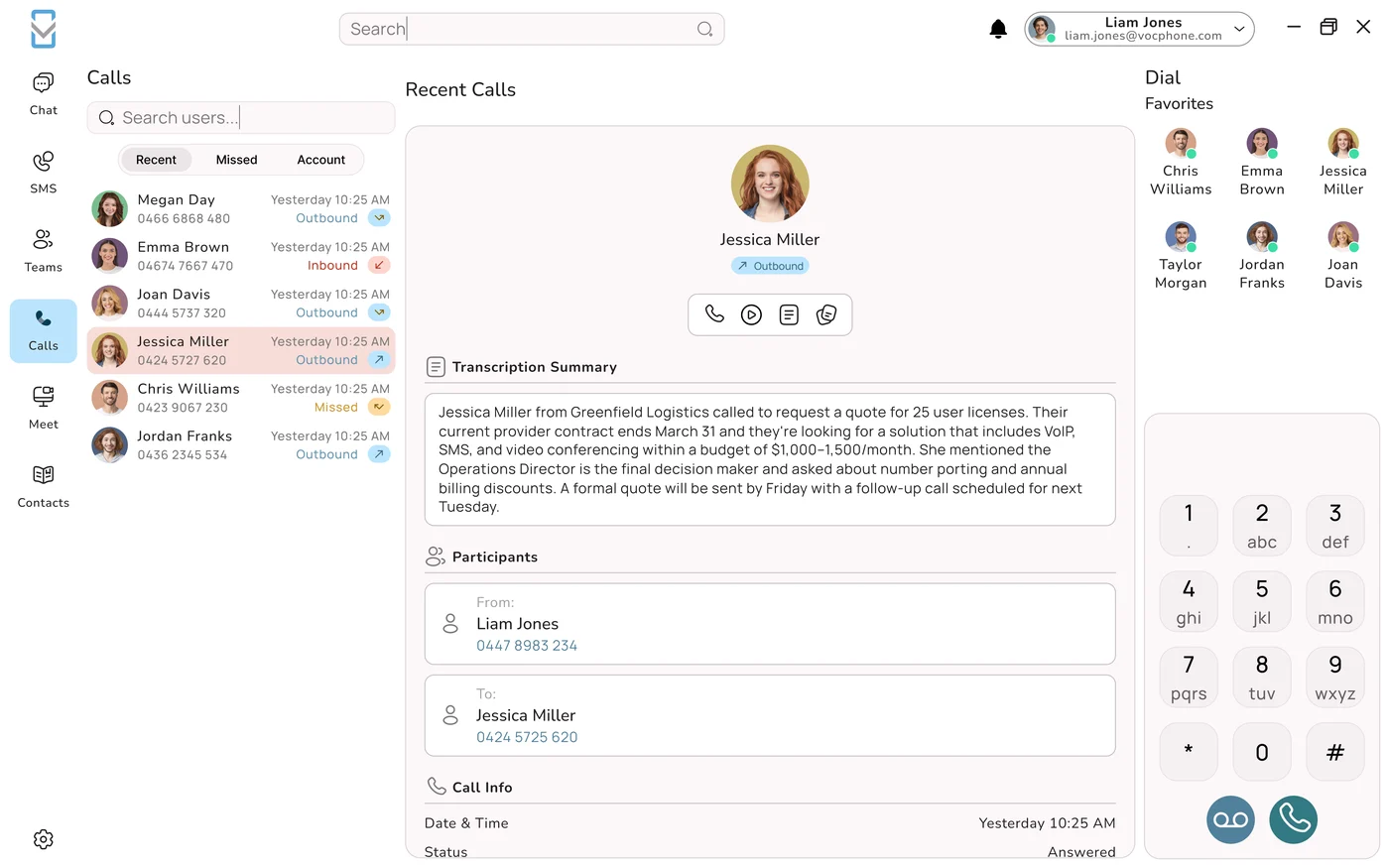
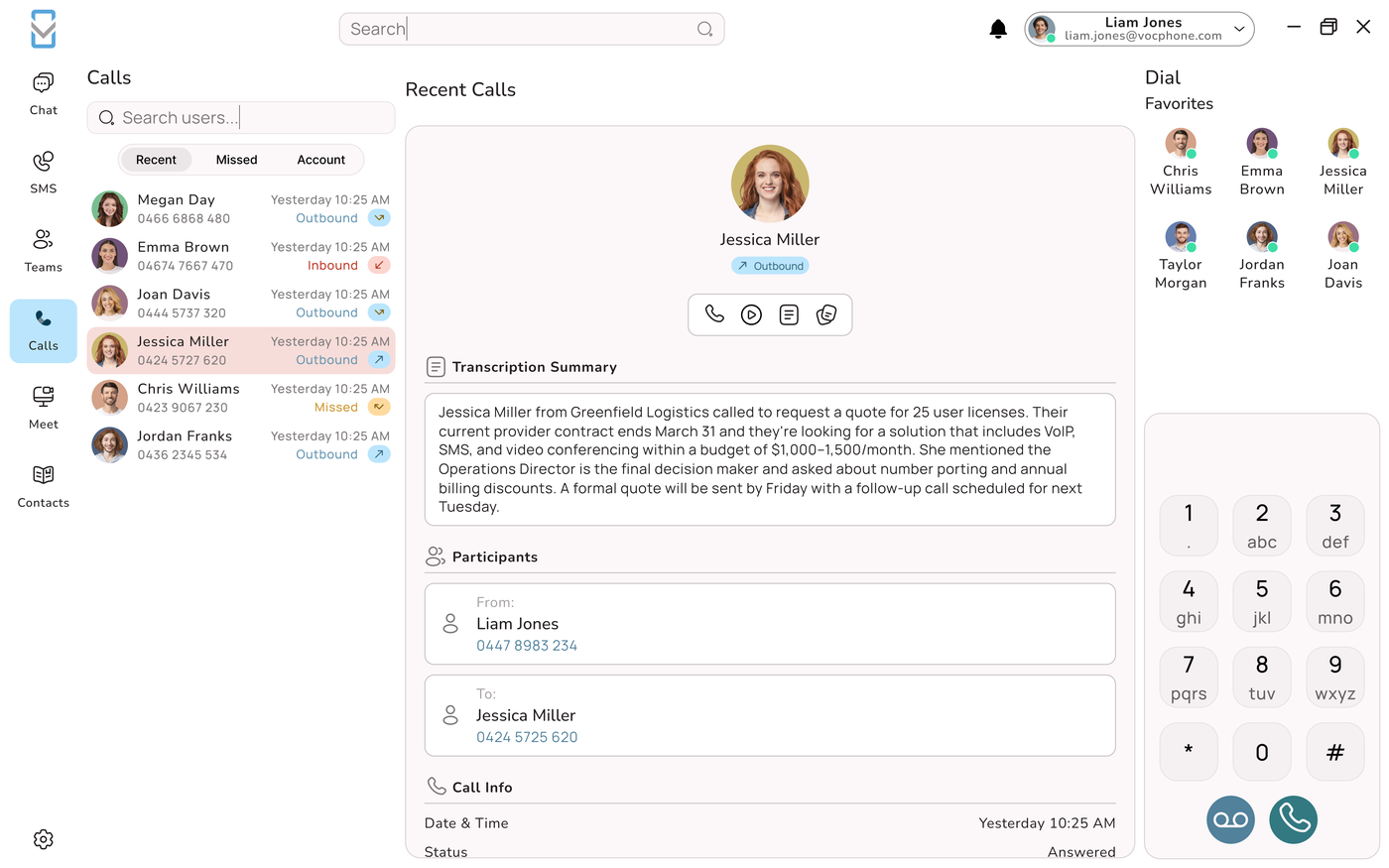
- Recordings in the call history of the desktop app, next to the call details, so the team plays them where they live instead of passing files around.
- Calls on the business number, so recorded conversations belong to the business, not someone's personal mobile.
- A local team to answer the provider questions in this audit, including storage location, who can reach recordings and your options for retention, on 1300 663 222 in business hours.
We have been running business phone systems in Australia for more than 15 years. If you work through the audit and want help with questions 10 and 11, give us a call. We would rather you ask than guess.
Frequently Asked Questions
How do I check if my call recordings are secure?
Work through twelve questions covering logins, former staff, copies, retention, card payments and your provider, scoring 2 for yes, 1 for partly and 0 for no. A score of 20 or more out of 24 means your recordings are under control, 12 to 19 is patchy and under 12 means they are exposed. The whole check takes about ten minutes with your phone system portal open.
How long should a small business keep call recordings?
Long enough to be useful, then delete them. Many small businesses choose somewhere between three and twelve months for general calls, and shorter periods for coaching-only recordings. Some industries have their own rules, for example tax practitioners keeping records of key client discussions and financial advisers keeping personal advice records, and those rules come first. This is general guidance, not legal advice.
Do I need a call recording policy?
If you record calls, a short written policy is the easiest way to make sure everyone handles recordings the same way. It should cover why you record, who can listen, where recordings are kept, how long they are kept, card payments, leavers, customer requests and what to do if something goes wrong. The one-page template in this guide covers all of these.
Is it OK for staff to download call recordings?
It is best avoided. Every downloaded file is a copy outside the phone system that will not be deleted on schedule and can be forwarded anywhere. Play recordings inside the phone system, and if one must be shared outside the business, have a manager approve it and keep a note of who received it and why.
Can customers read out card details on a recorded call?
They should not. Payment card industry rules do not allow card security codes to be stored after a payment is authorised, and that includes audio recordings. Send a payment link by SMS or email while the customer is on the line instead, and ask your provider how to deal with any older recordings that may contain card details.
Where does VOCPhone store call recordings?
VOCPhone records inbound and outbound calls with local or cloud storage on secure Australian infrastructure, and VOCPhone owns and operates its own network. Recordings appear in the call history of the desktop app. Our local team can explain storage, access and retention for your account on 1300 663 222.