











What Happens on the First Monday
Abstract descriptions of AI answering are not much use, so here is the concrete version. A plumbing business switches it on for after hours on a Friday afternoon.
| Time | What the caller experiences | What the business gets |
|---|---|---|
| Sat 7:40pm | Rings about a leaking hot water system. Assistant answers in two rings, says it is the virtual assistant, asks what is happening, establishes it is not flooding, takes name, address, phone and the make of the unit, books Monday 8am | A booked job in the diary before anyone has looked at a phone. Previously: a voicemail, maybe |
| Sun 10:15am | Rings to ask whether the business does gas fitting and what the callout fee is. Gets both answers in about twenty seconds and hangs up satisfied | A call that never needed a person, handled. No message to return on Monday |
| Sun 6:02pm | Water coming through a ceiling. Says “this is an emergency”. Assistant stops, confirms, transfers straight to the on-call mobile | The owner's phone rings with context already gathered. This path was designed first |
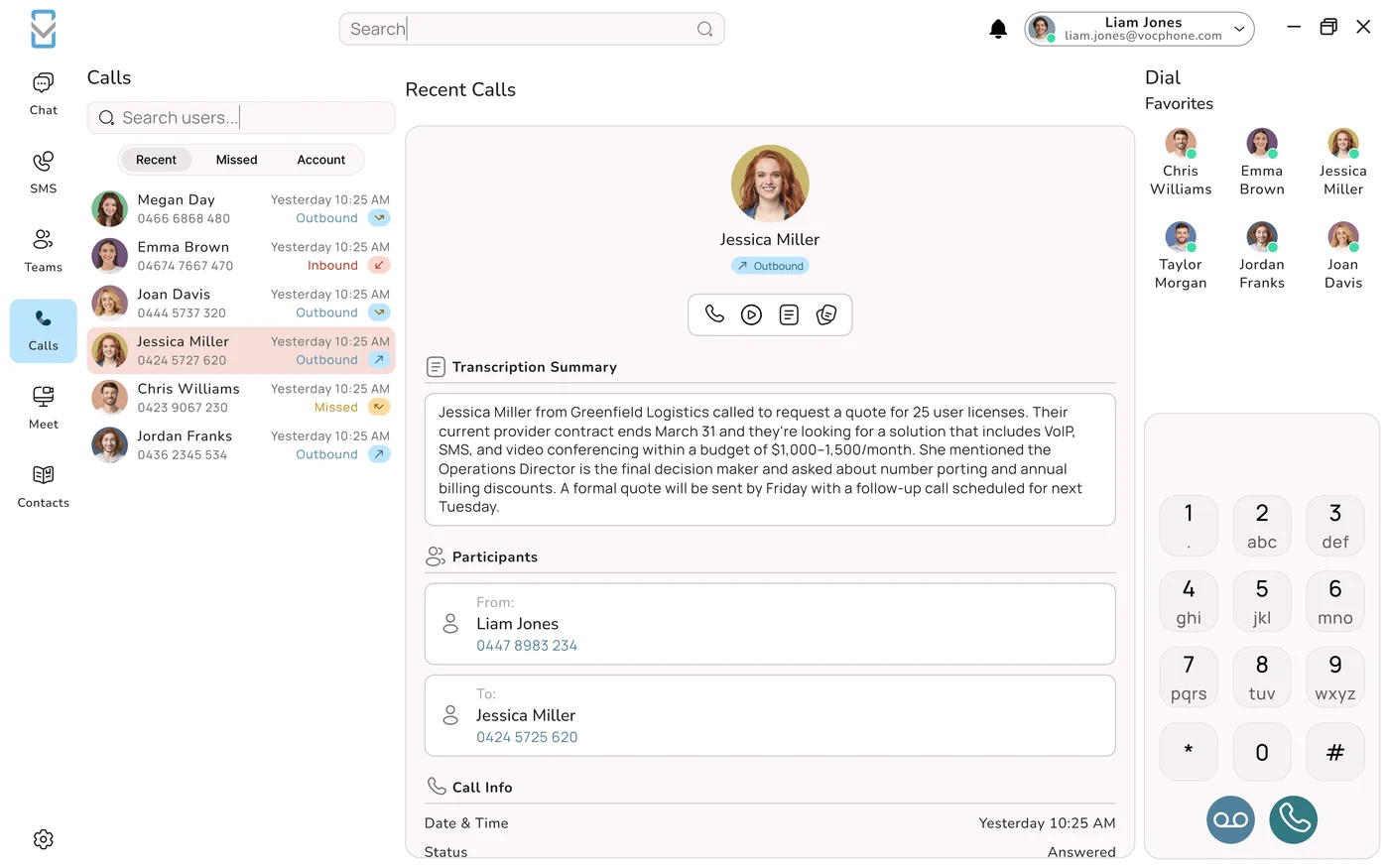
| Mon 7:55am | - | Owner opens the app to three transcripts, one booked job, one qualified lead and one emergency already handled. Total review time: four minutes |
Nothing in that weekend is exotic. Every one of those interactions previously ended in voicemail, an unanswered ring, or the customer ringing the next plumber on the list.
The comparison that matters is not “AI versus a great receptionist”. It is “AI versus what actually happens to your calls at 7:40 on a Saturday night”, and what actually happens is usually nothing.
Four Questions That Decide It
Answer these honestly and you will know within five minutes whether this is worth your time.
1. How many calls do you get a day?
Under about ten, the configuration effort outweighs the benefit: a good after-hours greeting and a missed-call text will get you most of the way for almost nothing. Above about twenty, the arithmetic gets compelling quickly. Between the two, it depends on how many you are currently missing.
2. Do the same conversations repeat?
If you can name your five most common calls without thinking, that is a strong yes. If genuinely every enquiry is different, bespoke consultative work, the assistant has no pattern to learn, and transcription and summaries will serve you better than answering will.
3. How upset are people when they ring?
Most businesses: not very. Some (insurers at claim time, complaint lines, anything involving distress or vulnerability) mostly are. If that is you, put people on the phone and use AI behind the scenes for notes and follow-up instead.
4. Is a specific person the product?
Some businesses are chosen precisely because a named individual answers. If that describes you, protect it. Automate the hours-and-parking calls and leave everything else alone: this is a real answer, not a cop-out.
If you answered yes, yes, not very, and no
You are the profile this works best for, and you can prove it inside a fortnight for very little outlay. Start with after-hours only and let the transcripts make the argument for you: they are far more persuasive than any projection.
The Six Jobs It Does Well
1. Capturing after-hours enquiries
The highest-value job by a distance, because the alternative is nothing. Someone who rings at 9pm and gets a useful conversation usually stops shopping around.
2. Booking into a real diary
Checks genuine availability, applies your rules about durations and buffers, writes into the actual calendar. No double bookings, no “I'll confirm and ring you back”.
3. The same twenty questions
Hours, location, parking, do you service that suburb, what does a callout cost, do you take that card. Enormous volume, near-zero value, perfectly repeatable.
4. Taking details accurately
Name, number, address, job type, urgency: captured and written down consistently. Better than a message on a serviette, and better than most people at 4:55pm on a Friday.
5. Overflow when everyone is busy
Ten people ring at once and all ten get answered. No queue, no engaged tone, no one deciding to try someone else while they wait.
6. Triage and routing
Working out what someone actually needs and getting them to the right place, including recognising urgency and escalating immediately rather than taking a message.
Notice what is not on that list: replacing your team. In practice AI answering removes the calls that were interrupting your team's real work, which is a different and more useful outcome than reducing headcount. Which calls to automate covers how to identify your own candidates properly.
The Voice, and Why the Accent Matters
Two decisions determine your customers' reaction, and both are made before a single call is answered.
| Decision | Why it matters more than it sounds |
|---|---|
| An Australian accent | Not a cosmetic preference. Callers relax noticeably faster with a local voice, and a foreign-sounding one reads as an offshore call centre: the exact impression an Australian business is usually working against. It also affects comprehension in both directions, since local place names, suburbs and idiom get handled properly |
| Saying it is an assistant | The worst available outcome is a caller realising mid-sentence that they have been talking to software and feeling deceived. Disclosing costs nothing, sets expectations about what it can do, and lets you advertise the way out before anyone needs it |
A disclosure line that works
“You've reached [business]: I'm the virtual assistant. I can book you in, answer questions, or put you through to someone. What can I do for you?” Three jobs in one sentence: disclose, set expectations, signpost the exit. Businesses that disclose get better reactions than businesses that try to pass. Trying to pass is what generates the complaints.
The third thing callers notice, and the one least discussed by vendors, is latency. A pause before the assistant responds is what makes people uneasy: more than any wording. When you are being shown a demonstration, ask to hear a genuine live call rather than a recording, and listen specifically for the gap.
The Escape Hatch
This single design rule matters more than any feature comparison, and it is free.
Anyone who asks for a person gets one. Immediately. No negotiation.
Not after two more qualifying questions. Not after being told the assistant can probably help. Asked once, granted instantly. If your assistant ever responds to “can I talk to a human” with anything other than the transfer, it is set up wrong, and every complaint you eventually receive will trace back to that moment.
Business owners resist this, understandably: the point was fewer calls reaching people, so an easy exit feels like undoing the work. It does the opposite, for three reasons.
- Knowing you can leave stops you wanting to. Most callers are perfectly happy to be booked in by an assistant. It is being trapped that makes people press zero repeatedly, not the automation itself.
- It is your best quality signal. The rate of “get me a person”, and where in the conversation it happens, tells you precisely what to fix. Suppress the requests and you have blinded yourself to your own failure points.
- It protects your best customers. The people most likely to want a human are the ones with the most complicated and most valuable business. Making them argue with software is exactly how you lose one.
After hours, when there is no one to transfer to, the equivalent promise is: take the details, say clearly when someone will ring back, and then ring back when you said. The promise is the product. An assistant that captures beautifully and is followed by silence on Monday is worse than voicemail.
Live by Friday
Five days, and most of it is writing rather than technology.
| Day | What happens |
|---|---|
| Monday | Tally last week's calls into five or six categories with a tick sheet by the phone. This is the most valuable hour of the week and nearly everyone is surprised by the result |
| Tuesday | Write out the answers to your ten most common questions the way you would actually say them out loud. This is the configuration: a writing job for whoever knows the business, not a technical one |
| Tuesday | Write the escalation rules. What counts as urgent, who it goes to, what triggers an instant transfer. Design the human path before the automated one |
| Wednesday | Connect the calendar. Set durations, buffers, and the things it must never book. Choose the voice and write the disclosure line |
| Thursday | Test it badly on purpose. Mumble. Interrupt it. Ask something odd. Say “I want a person” three seconds in. Test the awkward paths, not the ones you designed |
| Friday | Go live for after hours only. Business hours keep ringing people. Lowest-risk launch there is |
| Following week | Read every transcript. Fix the three worst answers. Twenty minutes, twice: that is the entire tuning process |
Five Ways It Goes Wrong
Every failed implementation we have seen is one of these five, and all five are avoidable.
| Mistake | What it produces | Fix |
|---|---|---|
| 1. Automating everything at once | A system trying to handle calls it was never configured for, failing publicly and visibly | One category. After hours. Then extend on evidence rather than on schedule |
| 2. Making the human path hard | Complaints, bad reviews, and customers who tell other people about it | Ask once, transfer immediately. Always |
| 3. Capturing without following up | Worse than voicemail, because you promised a callback and did not make it | Whoever owns the callback owns it before you go live. Not “we'll sort that out” |
| 4. Never reading the transcripts | The same wrong answer given a hundred times, invisibly | Twenty minutes, twice a week, for the first month. Then monthly |
| 5. A foreign-sounding voice | Callers assume an offshore call centre and adjust their expectations downward before saying anything | Australian voice. Non-negotiable for an Australian business |
1
Category to start with
5
Days to live
10
Answers to write
40m
Weekly tuning, month one
The Six Numbers That Prove It
Do not measure how many calls the AI handled. That number rises whether or not anybody was helped.
| Number | What it tells you |
|---|---|
| Bookings made outside business hours | Revenue that did not previously exist, directly attributable. The most persuasive figure in the set |
| Containment: calls finished without a person | The headline, and dangerous on its own. Always read it with the next row |
| Abandonment during the AI conversation | People hanging up on it. High containment plus high abandonment means it is outlasting callers, not resolving them |
| Requests for a human, and when | Your fix list, in order. A cluster at the same conversational moment is a wording problem you can fix today |
| Voicemails left, before and after | Should drop sharply. If it has not, the assistant is not capturing what people actually want |
| Callbacks needed after an AI call | Whether it finished the job or just added a step before a person did it anyway |
The full cost and ROI model works these through with worked examples, including how to value a captured after-hours enquiry honestly rather than optimistically.
The Rules, Briefly
| Area | Position |
|---|---|
| Privacy | Amendments to Schedule 1 of the Privacy Act 1988, inserted by the Privacy and Other Legislation Amendment Act 2024, commence 10 December 2026 and require privacy policies to disclose the kinds of personal information used in automated decisions and the kinds of decisions made. It is a disclosure obligation, not a ban, not compulsory human review, and not a right to reasons for a particular decision |
| Call recording | Engages state and territory surveillance devices legislation, with consent rules that differ by jurisdiction. Since you cannot choose where your callers are, announce recording on every call as a single national policy |
| Emergencies | An assistant must never sit between a caller and an emergency. Build and test that path before anything else goes live |
| Accessibility | Callers using the National Relay Service go through a relay officer, adding many seconds per turn. Extend timeouts and allow repeats, so a slow reply is never treated as no reply |
The honest bottom line
If you are missing calls after hours, if the same handful of questions eats your day, or if bookings slip because nobody could pick up: yes, AI can answer those calls, and you can prove it in a fortnight. If your callers are usually distressed, if every enquiry is genuinely unique, or if people ring specifically to talk to you, then no, and no amount of 2026 enthusiasm changes that. Both answers are respectable. What is not is handing over “the phones” without deciding which is which.
Further reading: the complete AI business phone systems guide, AI versus a human receptionist on cost, and where a small business should start with AI if the phones are only part of the question.
Frequently Asked Questions
Can AI actually answer my business calls?
Yes, for a specific set of calls, and the whole value of the exercise is knowing which ones before switching anything on. Current AI voice answering is genuinely good at six jobs: capturing after-hours enquiries, which is the highest-value use because the alternative is nothing; booking into a real diary by checking genuine availability and applying your rules about durations and buffers; answering the same twenty questions about hours, location, parking, service areas and callout fees; taking details such as name, number, address, job type and urgency accurately and consistently; handling overflow so that ten simultaneous callers all get answered rather than queued; and triaging calls to the right place including recognising urgency and escalating immediately. It is not good at upset people, genuinely unusual requests that resemble nothing it was configured for, or anything where being confidently wrong is expensive. The comparison that matters is not AI against an excellent receptionist: it is AI against what actually happens to your calls at twenty to eight on a Saturday night, and what actually happens is usually nothing at all.
How do I know if AI answering suits my business?
Four questions. How many calls do you get a day, under about ten and the configuration effort outweighs the benefit, so a good after-hours greeting and a missed-call text will get you most of the way for almost nothing, while above about twenty the arithmetic becomes compelling quickly. Do the same conversations repeat: if you can name your five most common calls without thinking, that is a strong yes, whereas if every enquiry is genuinely different because the work is bespoke and consultative, the assistant has no pattern to learn and transcription with summaries will serve you better than answering. How upset are people when they ring: most businesses, not very, but some such as insurers at claim time, complaint lines or anything involving distress or vulnerability mostly are, and if that is you, put people on the phone and use AI behind the scenes for notes and follow-up. And is a specific person the product: some businesses are chosen precisely because a named individual answers, and if that describes you, automate the hours-and-parking calls and leave everything else alone. Yes, yes, not very and no is the profile this works best for.
What do my customers hear when AI answers?
A conversational voice rather than a keypad menu: nobody presses one. The caller says what they want in their own words and the assistant responds, asks follow-up questions, and takes action such as booking an appointment or transferring the call. Two decisions made before any call is answered determine how well that lands. The first is the accent: an Australian voice is not a cosmetic preference, because callers relax noticeably faster with a local voice, a foreign-sounding one reads as an offshore call centre which is the impression most Australian businesses work against, and comprehension improves in both directions since local place names, suburbs and idiom get handled properly. The second is disclosure: say plainly and early that it is a virtual assistant, because the worst available outcome is a caller realising mid-sentence that they have been talking to software and feeling deceived. A line such as 'You've reached this business, I'm the virtual assistant, I can book you in, answer questions or put you through to someone' does three jobs at once. The third thing callers notice, and the one vendors discuss least, is latency: a pause before the reply is what makes people uneasy, so ask to hear a live call rather than a recording in any demonstration.
Should callers be able to reach a human easily?
Yes, and this single rule matters more than any feature comparison. Anyone who asks for a person gets one immediately, with no negotiation, not after two more qualifying questions, not after being told the assistant can probably help. Asked once, granted instantly. If your assistant ever responds to a request for a human with anything other than the transfer, it is configured wrongly, and every complaint you eventually receive will trace back to that moment. Business owners resist this because the point was fewer calls reaching people, so an easy exit feels self-defeating, but it works the other way for three reasons. Knowing you can leave stops you wanting to, and most callers are perfectly happy to be booked in by an assistant: it is being trapped that makes people press zero repeatedly. The rate of requests for a human, and where in the conversation they occur, is your single best quality signal, so suppressing them blinds you to your own failure points. And the people most likely to want a human tend to have the most complicated and most valuable business, so making them argue with software is precisely how you lose one.
How long does it take to set up AI call answering?
About five days, and most of it is writing rather than technology. Monday, tally last week's calls into five or six categories using a tick sheet by the phone: the most valuable hour in the exercise, and nearly everyone is surprised by the result. Tuesday, write out the answers to your ten most common questions the way you would actually say them aloud, which is the configuration itself and is a writing job for whoever knows the business rather than a technical one, and write the escalation rules covering what counts as urgent, who it goes to and what triggers an instant transfer, designing the human path before the automated one. Wednesday, connect the calendar and set durations, buffers and what it must never book, then choose the voice and write the disclosure line. Thursday, test it badly on purpose (mumble, interrupt, ask something odd, and demand a person three seconds in) because you need to test the awkward paths rather than the ones you designed. Friday, go live for after hours only, leaving business hours ringing people, which is the lowest-risk launch available. The following week, read every transcript and fix the three worst answers.
How do I measure whether AI answering worked?
Six numbers, and not the one most people reach for: how many calls the AI handled rises whether or not anybody was helped. Bookings made outside business hours is revenue that did not previously exist and is directly attributable, making it the most persuasive figure in the set. Containment, meaning calls finished without a person, is the headline but is dangerous read alone. Abandonment during the AI conversation means people hanging up on it, and the critical insight is that high containment alongside high abandonment does not mean the assistant is resolving calls: it means it is outlasting people. Requests for a human, and specifically when they occur, form your fix list in priority order, since a cluster at the same conversational moment is a wording problem you can fix that day. Voicemails left before versus after should drop sharply, and if they have not, the assistant is not capturing what callers actually want. And callbacks needed after an AI call tell you whether it finished the job or merely added a step before a person did it anyway.
What are the common mistakes with AI phone answering?
Five, and all are avoidable. Automating everything at once produces a system handling calls it was never configured for and failing publicly, so start with one category, after hours, and extend on evidence rather than on a schedule. Making the human path hard produces complaints, bad reviews and customers who tell other people about it, so the fix is asking once and transferring immediately, always. Capturing enquiries without following up is worse than voicemail, because you promised a callback and did not make it, so whoever owns the callback must own it before you go live rather than being sorted out later. Never reading the transcripts means the same wrong answer gets given a hundred times invisibly, so budget twenty minutes twice a week for the first month and monthly thereafter: that is the entire tuning process. And a foreign-sounding voice causes callers to assume an offshore call centre and adjust their expectations downward before they have said anything, which for an Australian business makes an Australian voice non-negotiable. Every failed implementation we have seen is one of those five.