











Business VoIP, Defined
VoIP stands for Voice over Internet Protocol. Strip away the acronym and it is simply a phone system that sends your business calls over the internet rather than down the old copper telephone lines. Your voice is sampled, converted into digital data, carried across your internet connection, and reassembled at the far end in a fraction of a second. To the people on the call it sounds like any other phone conversation. Underneath, it is a completely different and far more capable technology.
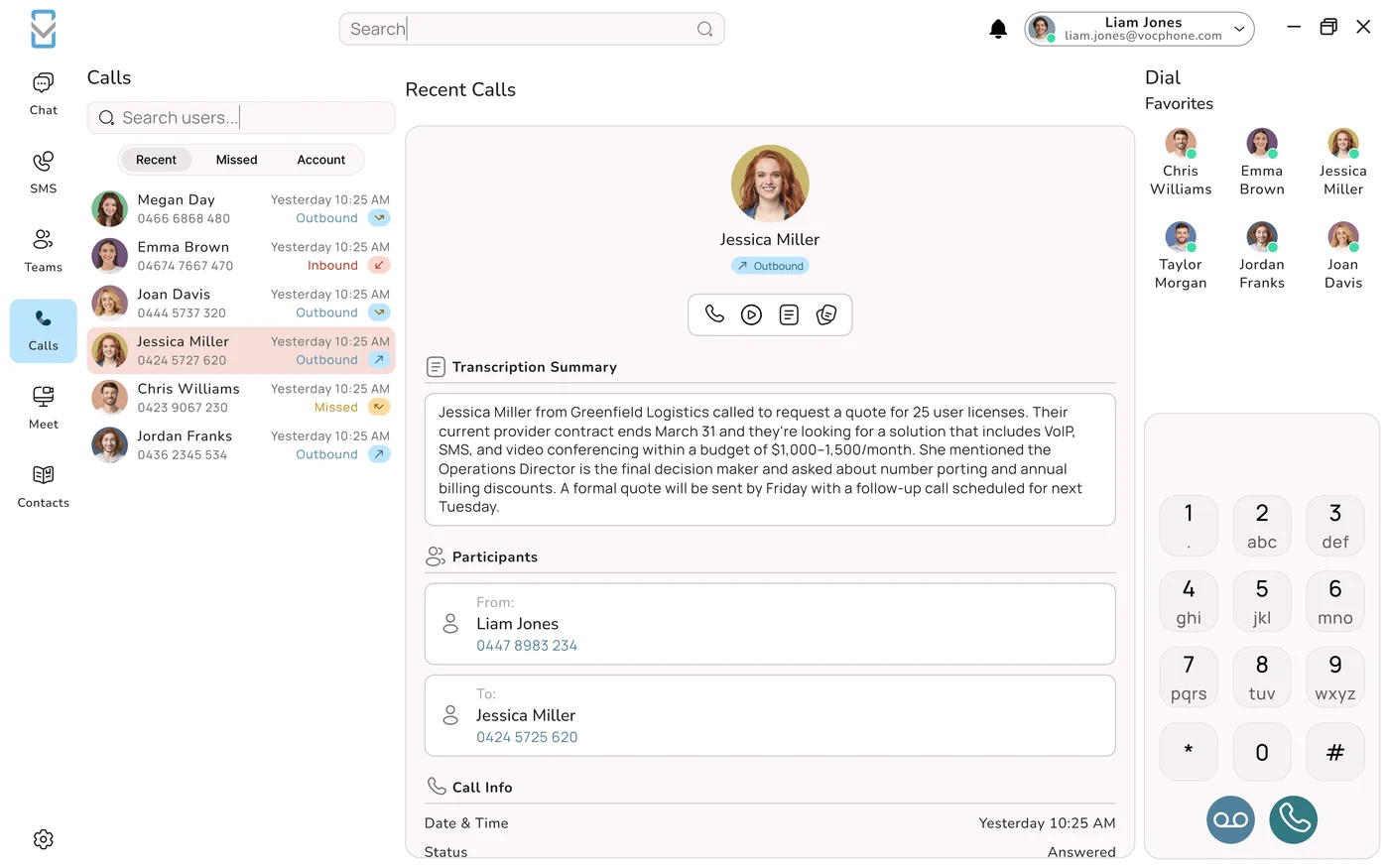
The important shift is that a VoIP phone system is software, not a box bolted to a wall. That single fact changes what a phone can do. Your business number is no longer welded to one desk or one building: it can ring on a handset, a computer and a mobile at the same time. Layer on auto-attendants, intelligent routing, voicemail-to-email, call recording and analytics, and you have a phone system that does things a traditional line simply cannot, usually for a fraction of the monthly cost.
When Australian businesses search for a "VoIP phone system", a "VoIP provider" or "cloud calling", this is what they are after: internet-based business telephony delivered as a service. You do not buy a phone switch and hide it in a cupboard. A provider hosts the platform, keeps it patched and updated, and you pay a predictable monthly fee per user that scales up and down with your headcount, the way a software subscription does rather than a capital purchase you depreciate over years.
Business VoIP is not the consumer VoIP on your phone
You almost certainly already use consumer VoIP without thinking about it. Calling a friend through WhatsApp or Messenger is VoIP. Business VoIP is a different animal built for a different job. It gives you real, dialable phone numbers, local, national, mobile and 1300/1800 inbound, along with guaranteed call quality, professional call handling, admin controls, integrations with the software you run, and a provider you can actually ring when something needs attention. It is engineered to run a business, not to chat.
1
business number that follows you across every device
99.99%
network uptime on VOCPhone's own infrastructure
15+
years VOCPhone has operated in the Australian market
🇦🇺
Australian-owned, hosted and supported
Under the Hood: Voice to Data and Back
You do not need an engineering degree to buy a phone system, but a working mental model of how VoIP moves your voice helps you ask sharper questions and understand exactly where call quality comes from.
Your voice becomes packets
When you speak into a handset, headset or app, the device samples your voice and turns it into digital data. That data is chopped into small chunks called packets, each stamped with an address, and streamed across your internet connection to your provider's servers, which route the call onward to its destination. At the other end the packets are reassembled and converted back into sound. This happens continuously, in both directions, dozens of times a second, which is why a VoIP call feels like a normal live conversation rather than a walkie-talkie.
Codecs make it efficient
A codec is the software that compresses your voice so it travels efficiently and decompresses it on arrival. Good codecs deliver crisp, natural audio using surprisingly little bandwidth, a single call typically consumes well under 100 kbps each way. That means even a modest business connection can comfortably carry several simultaneous calls. The practical point: VoIP is not bandwidth-hungry, but it is sensitive to the quality and stability of your connection, not just its headline speed.
Latency, jitter and packet loss: where quality lives
Because voice is real-time, three things shape call quality more than raw download speed. Latency is the delay between speaking and being heard; too much and people talk over each other. Jitter is variation in when packets arrive; too much and audio turns choppy. Packet loss is data that never arrives, heard as dropouts. This is precisely why the location of your provider's network matters so much. When voice has to travel to servers in Singapore, the United States or Europe and back, the round trip lengthens and quality degrades. Keeping the network onshore keeps that trip short, and it is the single biggest lever on call quality a provider controls.
The Plain-English Version
VoIP turns your voice into data, sends it over the internet, and turns it back into sound. It barely touches your bandwidth, but it cares deeply about a stable, low-latency connection. That is why a solid business internet service paired with an Australian network operator like VOCPhone delivers call quality that matches or beats the old copper line, without copper's cost or limits. Because VOCPhone runs its own network rather than reselling capacity, it controls that round trip end to end.
VoIP, Landline, PBX & UCaaS Untangled
Four terms get muddled constantly, and the confusion costs money, either overpaying for a platform you do not need or underbuying a bare line when you need more. Here is the clean version.
The traditional landline and on-premise PBX
A landline sends your voice as an analogue signal down a dedicated copper wire from the exchange to your premises. To give a business multiple extensions, you historically added an on-premise PBX: a physical phone switch installed in your building, wired to desk phones and maintained by technicians. It is familiar and reliable, but expensive to buy and run, rigid, voice-only, tied to one address, and sitting on the copper network Australia has now largely retired.
Business VoIP: the modern calling layer
Business VoIP replaces both the copper line and the physical switch with a cloud service. You keep all the call handling of a PBX, extensions, IVR menus, hunt groups, voicemail, transfers, and gain mobility and features a legacy box never had, delivered over the internet with no hardware to maintain. This is also where "cloud PBX" and "hosted PBX" sit: they are VoIP delivering business phone functionality from the cloud. We compare the two infrastructure models in detail in our guide to hosted PBX vs on-premise PBX.
UCaaS: the whole communications stack
UCaaS (Unified Communications as a Service) uses VoIP for calling but adds HD video meetings, team messaging, business SMS, presence, mobile and desktop apps, integrations and AI, all managed from one system with one bill. In one line: VoIP is phone calls in the cloud; UCaaS is your entire communications stack in the cloud. The good news is that the choice is not either/or. VOCPhone gives you proper Australian VoIP calling inside a full unified platform, so you get the calling you came for and the rest as it earns its place. For the deeper picture, see what UCaaS is and how it differs from VoIP.
| Capability | Landline / On-Prem PBX | Business VoIP | Full UCaaS (VOCPhone) |
|---|---|---|---|
| Voice calling | ✓ Copper / on-site | ✓ Over the internet | ✓ Over the internet |
| Mobile + desktop apps | ✗ Desk phone only | ✓ Included | ✓ Free, all platforms |
| Auto-attendant & routing | ~ Extra hardware | ✓ Built in | ✓ Built in |
| Video meetings & messaging | ✗ | ~ Sometimes | ✓ Built in |
| AI Phone Agents | ✗ | ~ Rare / add-on | ✓ Included |
| CRM & accounting integrations | ✗ | ~ Limited | ✓ Xero, Salesforce, HubSpot, Zoho+ |
| Scale up or down | ✗ Hardware project | ✓ Minutes | ✓ Minutes |
| Runs on retired copper PSTN | ✗ Being switched off | ✓ Future-proof | ✓ Future-proof |
| Owns the underlying network | ~ Carrier-dependent | ~ Often a reseller | ✓ VOCPhone operates its own |
The pattern is hard to miss. A landline and PBX is dependable but rigid, costly, voice-only and living on borrowed time. Business VoIP delivers everything the old system did plus mobility and modern features, at a lower cost. Full UCaaS stacks video, messaging and AI on top. For most Australian businesses upgrading in 2026, the question is not whether to move to VoIP, but which provider to trust with it.
Why VoIP Became the Default
If you have felt a nagging sense that you should "sort out the phones", there is a concrete reason behind it. Australia's traditional fixed-line network, the copper PSTN, along with older ISDN services, has been progressively decommissioned as part of the nationwide NBN migration. The analogue and ISDN lines businesses leaned on for decades are being switched off, area by area, and services are moving to internet-delivered voice.
This is not a marketing scare; it is infrastructure reality. As copper is retired, businesses still running on legacy lines and ISDN-connected PBX systems have to migrate whether they planned to or not. The practical upshot is that VoIP has quietly gone from "the modern alternative" to "the default way an Australian business gets a phone line". There is no longer a copper path to fall back on.
What the switch-off means for you
- Still on copper or ISDN? Plan your migration on your own timetable rather than waiting for a disconnection notice. Moving by choice is far calmer than moving under a deadline.
- Your numbers are safe. The switch-off retires the underlying copper, not your right to your phone number, which you port to a VoIP provider (covered below).
- Treat it as an upgrade, not a chore. Migrating is the natural moment to move from a voice-only line to a platform with mobility, AI and integrations, often for less than you were paying.
The Bottom Line on the Switch-Off
Retiring the copper PSTN has removed the "do nothing" option. Every Australian business will end up on internet-based voice; the only real choice is whether you pick a quality provider proactively or scramble when the line goes dead. VOCPhone makes the move painless: your existing numbers port across, your current service stays live until the switch completes, and Australian-based support guides the whole thing.
What Business VoIP Actually Gives You
Moving your phones to VoIP is not just tidier; it changes what a phone system can do for the business. These are the benefits that show up on the balance sheet and in the daily grind.
Lower, Predictable Cost
No copper line rental, no PBX hardware to buy or maintain, and cheaper calls. A single per-seat subscription typically undercuts a traditional line-and-PBX setup by a wide margin.
True Mobility
Your business number follows you. Answer the office line from home, hand a call to a colleague on site, and take calls on your mobile, all on one number and one system.
Scales in Minutes
Adding a user is a setting change, not a technician visit. Bring on staff for a busy season and remove them afterwards, with no recabling and no new hardware.
Features Built In
Auto-attendants, call routing, voicemail-to-email, call recording, hold music, ring groups, call queues and analytics, capabilities that once cost thousands in PBX add-ons.
Integrations
Connect the phone system to the tools you already run, Salesforce, HubSpot, Zoho, Xero, Monday and 1000+ apps via open APIs, so calls, contacts and records stay in sync.
Business Continuity
If your office loses power or internet, calls reroute to mobile apps or another number automatically. Customers never know there was a problem.
Never miss the call that pays the bills
For many small businesses the biggest hidden cost is the call that rings out. A missed call is often a missed job or a lost customer. VoIP lets you route calls intelligently, ring multiple devices, cascade to the next available person, and fall back to a professional voicemail, or, on VOCPhone, to an AI Phone Agent that answers in a natural Australian accent, qualifies the caller, books the appointment and routes the enquiry while your hands are full. If you run a trades business, our guide to the best phone system for tradies goes deeper on exactly this.
"The whole point of VoIP is that your phone system stops being a place you have to be and becomes something you carry with you. The number rings wherever the work is."
VOCPhone, Voice over Cloud
The Honest Trade-Offs (and Fixes)
No technology is flawless, and a guide that only lists upsides is an advertisement. Here are the genuine trade-offs of business VoIP, and, just as importantly, how a well-run provider neutralises each one.
It depends on your internet
The headline caveat: no internet, no VoIP on that connection. If your link drops, calls riding it drop too. In practice this matters far less than it sounds, because a cloud platform is not chained to your office link. When the office internet fails, incoming calls reroute automatically to the mobile app (running on mobile data) or to another number. So while a single connection can fail, your phone service does not have to. The fix is a provider with real failover and a decent business connection to begin with.
It depends on power
Unlike an old analogue line that drew power from the exchange, VoIP handsets and networking gear need mains power. A blackout can take desk phones and your router offline. The mitigation is simple: calls fail over to mobile apps automatically, and businesses that need guaranteed desk-phone uptime add an inexpensive UPS to keep the router and phones alive through short outages. Again, this beats an on-premise PBX, which goes completely dark with the building.
Call quality reflects the setup
VoIP sounds excellent when the connection and provider are good, and noticeably worse when they are not. The culprits are almost always the same three: an overloaded or unstable connection, cheap networking gear, or a provider whose network sits offshore and adds latency. The fixes are equally clear, prioritise voice traffic on your network (QoS), run a stable business connection, and choose a provider whose network is in Australia so your voice is not making a round trip across an ocean. If you do hit trouble, our VoIP and SIP troubleshooting guide walks through the fixes.
Don't Judge VoIP by a Bad Provider
Most "VoIP sounds terrible" stories trace back to one of three things: a poor internet connection, budget hardware, or an offshore-hosted reseller adding latency. None of these are inherent to VoIP. On a stable connection, with a network operator hosting onshore and proper failover, VoIP quality and reliability match or exceed the old copper line while doing far more. Ask any prospective provider two blunt questions: where does your network live, and what happens to my calls in an outage?
Emergency calling works differently
Because a VoIP number is not welded to a fixed address the way copper was, emergency (000) calling relies on the service address registered against your account and the device's connectivity. Reputable Australian providers handle this correctly and keep your registered address current, but it is worth confirming how emergency calls are managed, especially for staff who carry the business number across locations.
How VoIP Is Priced
Understanding the pricing models lets you compare quotes fairly and spot the traps that turn a "cheap" plan expensive. Most Australian business VoIP falls into a couple of patterns.
Per-seat, per-month (the standard)
The most common and usually most sensible model: a flat monthly fee for each user, commonly somewhere between roughly $10 and $50 depending on the tier and what is included (figures are illustrative and vary by provider). The appeal is predictability, you know your bill in advance, and it scales cleanly as staff come and go. The thing to interrogate is what "included" actually means: are calls bundled, is AI part of the plan, and are the features you need in the tier you were quoted or one step up?
Metered / pay-per-minute
Some providers offer a low monthly base and charge per minute on top. That can suit a very low-volume user, but for a normal business it makes budgeting harder and can produce nasty surprises in a busy month. If you are quoted a metered plan, model your real call volumes before assuming it is cheaper.
The costs the headline hides
- Minimum seats: a "$30 per seat" plan with a three-user minimum is really $90 a month before you make a call.
- AI and analytics add-ons: features waved about in the headline can be separate line items on the invoice.
- Setup, onboarding and porting fees: one-off charges that quietly inflate the true first-year cost.
- Per-minute overages: "unlimited" plans sometimes carry fair-use caps.
- Lock-in: multi-year terms with break fees reduce your flexibility.
The honest way to compare is total cost across a realistic first year, base subscription plus every add-on you actually need plus setup and porting, divided by your real seat count. On that basis an all-inclusive plan often beats a low headline price. VOCPhone keeps it clean: transparent per-seat pricing with unlimited calling on plans and AI Phone Agents included, backed by a price guarantee that matches genuine competitor quotes, so the number you are shown is the number you pay. For a full breakdown, see our guide to business phone system costs in Australia.
Keeping Your Numbers: Porting Explained
The most common worry about switching to VoIP is "will I lose my number?" You will not. Keeping your number is called porting, and it is a standard, regulated process in Australia.
What you can port
You can port geographic (local) landline numbers, and you can port 1300 and 1800 inbound numbers, which are common for Australian business, to a VoIP provider. If you do not yet have an inbound number and want one, our guide on how to get a 1300 or 1800 number walks through the choices. Porting means your customers keep dialling the number they already know while everything behind it moves to the cloud.
How a zero-downtime switch works
Confirm your plan and numbers
Talk to a specialist, nail down your seats, the numbers to port, and the call flows you need. This is where surprises get caught early.
Lodge the port
Your new provider submits the porting request to your current carrier on your behalf. There is paperwork, and VOCPhone handles it for you.
Keep working while it processes
Crucially, your existing service stays live until the port completes, so there is no gap. Customers keep getting through the whole time.
Go live
Once the number cuts across, calls flow to your VoIP apps and handsets. Your customers never notice the machinery changed underneath.
With VOCPhone, porting is managed end to end, and because your old service stays active until the switch is complete, there is no downtime and no paperwork on your desk.
Security & Data Sovereignty
Because VoIP runs over the internet, security is a fair question, and a serious provider treats it as one. Two things matter most: how calls are protected in transit, and where your data physically lives.
How quality VoIP is secured
- Encryption in transit: reputable providers encrypt the voice media (via SRTP) and the signalling (via TLS), so calls cannot be trivially intercepted.
- Access controls: strong authentication, admin permissions and monitoring guard against unauthorised logins.
- Fraud monitoring: platforms watch for the unusual calling patterns that signal toll fraud and shut it down before it costs you.
- Central patching: because the platform is cloud-hosted, security updates are applied centrally, you are never running unpatched hardware in a cupboard.
Why data sovereignty is the bigger issue
Encryption is table stakes. The question many businesses overlook is jurisdiction: where are your calls, recordings, transcripts and customer records stored and processed? When that data sits on overseas servers, it falls under foreign jurisdictions and creates compliance exposure under the Privacy Act 1988 and the Australian Privacy Principles. For businesses in healthcare, finance, legal and government, onshore data handling is not a nice-to-have, it is a requirement. Because VOCPhone owns and operates its own Australian network, your voice and customer data stay in the country by design, not as an afterthought.
The Provider Question: Owner vs Reseller
VoIP feature lists look nearly identical on marketing pages, so evaluate providers on the things that actually determine your experience, your call quality and your total cost. The most revealing question of all is who owns the network.
1. Does the provider own the network, or resell someone else's?
Many "VoIP providers" are resellers: they buy capacity wholesale and put a logo on it. When something breaks, they are on the phone to their supplier just like you would be, and they cannot tune call quality, routing or failover because they do not control the underlying network. VOCPhone is different. It owns and operates its own network, which means it controls the path your voice takes end to end, can engineer for a 99.99% uptime record, and can fix problems directly rather than raising a ticket with a third party. This is the single biggest differentiator, and the one most worth asking about.
2. Australian hosting and support
Ask exactly where the infrastructure that carries your voice lives, and where the humans who answer support calls sit. "We have an Australian point of presence" is not the same as being Australian-owned, Australian-hosted and Australian-supported. Onshore infrastructure means lower latency (clearer calls) and keeps your data in the country. VOCPhone is Australian-owned with Australian-based 24/7 human support, backed by 15+ years operating in this market.
3. AI included versus AI upsold
Modern platforms increasingly bundle AI: agents that answer and route calls, transcription, summaries and analytics. But many providers gate AI behind their priciest tiers or charge separate per-seat or per-minute fees. Confirm whether AI is part of the plan you will actually pay for. VOCPhone includes AI Phone Agents, natural Australian-accent receptionists that answer 24/7, book appointments, qualify leads and route calls, as part of the platform. Our guide to AI business phone systems covers this in depth.
4. Real integrations and transparent pricing
Check for native, two-way integrations with the tools you already run, Salesforce, HubSpot, Zoho and Xero, not just a generic connector, and demand transparent per-seat pricing without surprise tiers, minimum-seat traps or per-minute overages. VOCPhone connects to 1000+ apps through open APIs, offers number portability so you keep your existing numbers, and backs its pricing with a price guarantee. For where it sits against the field, see our comparison of the best business phone systems in Australia.
The Short Checklist
Before you sign, get straight answers to five questions: Who owns the network? Where is it hosted and supported? Is AI included or an add-on? Can I keep my numbers? Is the price on the quote the price I pay? With VOCPhone the answers are: we own it, in Australia, included, yes, and yes.
Frequently Asked Questions
What is business VoIP, in plain English?
Business VoIP (Voice over Internet Protocol) is a phone system that carries your calls over the internet instead of down the old copper telephone lines. Your voice is turned into digital data, sent across your internet connection, and rebuilt at the other end so it sounds like a normal call. Because it is software rather than a wired box, the same business number can ring on a desk phone, a laptop and a mobile app, with call routing, voicemail-to-email and auto-attendants built in. VOCPhone is an Australian-owned VoIP platform that runs on its own network, hosts everything onshore and includes AI Phone Agents as standard.
How is VoIP different from a traditional landline?
A landline sends your voice as an analogue signal down a dedicated copper wire from the exchange to your building, so it is tied to one location and voice-only. VoIP sends your voice as digital packets over the internet connection you already have, so there are no separate phone lines to rent, your number works on any device anywhere, and you get modern features a landline never could. VoIP is also dramatically cheaper. With Australia's copper PSTN progressively retired under the NBN migration, VoIP has become the default way businesses get a phone line.
VoIP or UCaaS, which do I actually need?
VoIP is the calling layer: it moves phone calls over the internet. UCaaS (Unified Communications as a Service) uses VoIP for calling but wraps it in video meetings, team messaging, business SMS, presence, mobile and desktop apps, integrations and AI, all on one bill. Put simply, VoIP is phone calls in the cloud; UCaaS is your whole communications stack in the cloud. You do not have to choose: VOCPhone delivers proper Australian VoIP calling inside a full unified platform, so you get the calling you came for and the rest when it becomes useful.
What happens to my VoIP calls if the power or internet goes out?
Because VoIP lives in the cloud rather than in a box in your office, a local outage does not silence your business. If your office loses power or internet, incoming calls automatically reroute to the mobile app on your team's phones over mobile data, or to another number you nominate, so callers still get through. That is more resilient than an on-premise system, which dies with the building. VOCPhone owns and operates its own network with a 99.99% uptime record and automatic failover, so a problem at your end does not take your phones offline.
Can I keep my existing business number when I move to VoIP?
Yes. Keeping your number is called porting, and it is a standard, regulated process in Australia. You can port geographic landline numbers, mobile numbers and 1300 or 1800 inbound numbers to a VoIP provider. A well-run provider keeps your existing service live until the port completes, so there is no downtime and customers never notice. VOCPhone manages the whole porting process for you and keeps your old service running right up until the switch is done.
How much should business VoIP cost in Australia?
Most Australian business VoIP is priced per user, per month, commonly in the range of roughly $10 to $50 per seat depending on the features and included calls. The real cost hides in the fine print: minimum seat counts, AI and analytics locked to top tiers, per-minute call charges, and setup or porting fees. VOCPhone uses transparent per-seat pricing with unlimited calling on plans, AI Phone Agents included, and a price guarantee that matches genuine competitor quotes, so the figure you are shown is the figure you pay.
Is business VoIP secure enough for my customer data?
Yes, when the provider does it properly. Quality VoIP encrypts calls in transit using SRTP and TLS, enforces strong logins and admin permissions, and monitors for toll fraud. The bigger question for Australian businesses is data sovereignty: where your calls, recordings and customer records are stored and processed. Keeping that data onshore aligns you with the Privacy Act 1988 and the Australian Privacy Principles. VOCPhone hosts in Australia on infrastructure it owns and operates, with encryption and Australian-based human support.
What to Read Next
This guide is the pillar on business VoIP. These articles go deeper into the decisions around it, from comparing VoIP with a landline to costs, cloud systems and choosing the right fit for a small business.